Are keywords and search queries the same? How to use them for SEO?
-
A business owner writes a blog around one keyword and waits for traffic.
-
A customer goes to Google and types a much more specific question.
-
The page does not rank well because the content was built for a phrase, not for the real need behind the search.
That is where a lot of SEO confusion begins.
People often hear the words keywords, search terms, and search queries used as if they mean the same thing. In everyday conversation, that seems harmless. In real SEO work, it creates bad strategy, weak content planning, and pages that never quite reach the right audience. Search queries come from users. Keywords are the themes and phrases marketers choose to target. Search Console itself reports performance by the queries people typed, while Google’s own SEO guidance focuses on helping users find content that matches their needs.
So, are keywords and search queries the same?
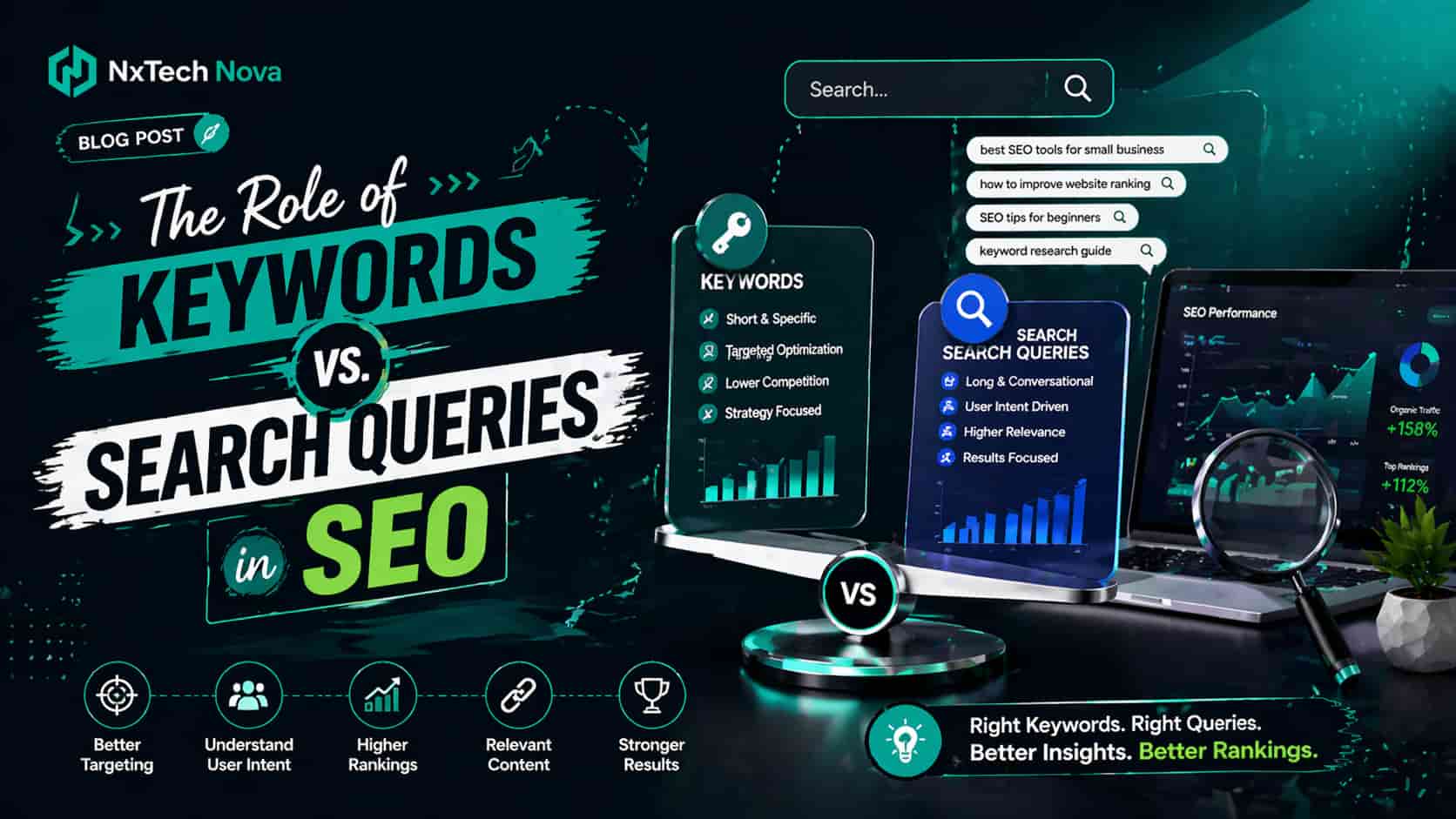
No. They are connected, but they are not identical. A keyword is your strategic target. A search query is the exact wording a person types or speaks into Google. One keyword can generate dozens or even hundreds of search queries. That is why smart SEO does not stop at picking phrases with search volume. It studies how people actually search, what they mean, and what kind of page Google is rewarding for that intent.
Here is the simplest way to think about it:
-
Keywords are what you plan around.
-
Search queries are what real people use.
-
Search intent is the reason behind those queries.
-
SEO works best when all three align on one page.
Many weak competitor blogs stop after saying “use keywords in your content.” That advice is too shallow for modern SEO. Search engines now evaluate meaning, context, and intent far better than they used to. Queries are also getting longer and more detailed, especially as users interact with AI driven search experiences and expect direct answers. That means your page has to solve the actual problem behind the search, not just repeat a phrase.
If you understand that early, your whole digital marketing strategy becomes stronger. You write better briefs. You choose better pages to create. You stop chasing vanity traffic. And you start building content that can rank, earn clicks, and convert.
What are the 3 main types of search queries users enter?
In practical SEO, there are three core query types you should master first:
-
Informational
-
Navigational
-
Transactional
Many SEO frameworks also include a fourth category called commercial investigation, which sits between research and buying. But if you are a beginner, learning the three core buckets first will already improve your keyword strategy a lot.
1. Informational queries
These are searches made by people who want to learn something.
Examples include:
-
what is keyword research
-
how to improve website traffic
-
what is the definition of SEO in organic search
The user is not necessarily ready to buy. They want an answer, a process, a guide, or clarity. This is where blog posts, explainers, checklists, and educational landing pages perform best. Informational queries are often the starting point of the customer journey, which is why strong SEO content marketing matters so much. If your site helps early, you earn trust before the buying stage even begins.
2. Navigational queries
These are searches where the user already knows where they want to go.
Examples include:
-
google search console
-
nxtechnova SEO
-
ahrefs keyword research
The person is using Google as a shortcut. They are not comparing ten options. They are trying to find one brand, one page, one login, or one known destination. If your brand is growing, navigational demand becomes a strong signal that people already know you. It also helps you separate branded traffic from non branded discovery traffic when you measure performance. Google even added more ways to analyze branded queries in Search Console Insights, which shows how important query level analysis has become.
3. Transactional queries
These come from users who want to take action now.
Examples include:
-
hire SEO consultant
-
web development company near me
-
content marketing services near me
This is where service pages, pricing pages, demos, consultations, and lead forms matter most. Transactional searches are high intent. They are also where many businesses lose easy wins because they send buyers to thin pages with weak messaging, generic headings, or no proof of relevance. If your page targets a transactional keyword, it should make the next step obvious and easy.
A simple rule helps here. If the user wants to know, give them content. If they want to go, give them the right page. If they want to act, give them a conversion path.
That is also why search queries matter more than many people realize. A keyword list may say “SEO services.” But the real search query might be “best SEO company for small business in London” or “who can improve Shopify rankings fast.” Those variations reveal urgency, context, industry, and buyer stage. When you ignore that detail, your page becomes broad. When you use it well, your page becomes relevant.
How to do keyword research in digital marketing for beginners?
Beginner keyword research feels overwhelming because tools show thousands of phrases, huge spreadsheets, and conflicting data. The easiest way to avoid confusion is to stop thinking like a tool and start thinking like your customer.
Keyword research begins with problems, not platforms.
Ask yourself what your audience is trying to solve. In digital marketing, that might be low traffic, poor conversions, weak local visibility, slow growth, unclear ROI, or a site that ranks for the wrong terms. Once you know the real problems, your keyword research becomes focused and useful instead of random. Ahrefs recommends starting with terms and phrases your customers might naturally use, while Google Search Console lets you see the queries already bringing impressions and clicks to your site.
Here is a beginner friendly process that actually works.
Step 1. Start with seed topics
Write down five to ten broad themes related to your service or business.
For a digital marketing brand, that could be:
-
SEO
-
keyword research
-
local SEO
-
content marketing
-
technical SEO
-
digital marketing strategy
-
website traffic
-
Google rankings
These are not final target keywords. They are starting points.
Step 2. Expand each topic into real query ideas
Now turn each theme into what people may actually search.
For example, “keyword research” can expand into:
-
how to do keyword research in digital marketing
-
keyword research for beginners
-
how to choose keywords that rank
-
keyword research for small business website
-
what is the role of keyword research in digital marketing success
At this stage, use Google autocomplete, People Also Ask, related searches, and Search Console query data. Search Console is especially valuable because it shows the real queries where your site already appears, including clicks, impressions, CTR, and average position. That tells you what Google already associates with your site and where low effort wins may exist.
Step 3. Group keywords by intent
This is where many beginner guides are too weak.
Do not collect keywords in one giant list and call it research. Group them by what the user wants.
A clean way to do it is:
-
Informational for blog posts and guides
-
Commercial for comparison and evaluation pages
-
Transactional for service and sales pages
-
Navigational for branded pages and destination searches
If you skip this step, you may accidentally write a blog post for a keyword that really needs a service page, or create a service page for a keyword that clearly needs an educational guide. That mismatch is one of the biggest reasons pages fail to rank.
Step 4. Check the search results before choosing the keyword
Never trust volume alone.
Search the phrase and look at the page types already ranking. Are they blog posts, product pages, category pages, videos, tools, or local service pages? Google’s results tell you what kind of content users expect for that query. If the top results are beginner guides, your sales page probably will not rank there. If the top results are service pages, your blog article may struggle too.
Step 5. Choose one primary keyword and supporting variations
Each page should have a main focus, but it should not be written like a robot repeating one phrase. Use one primary keyword, then support it with close variations, semantic phrases, common questions, and natural language that answers the topic fully.
For this blog, for example, the page could target a primary idea around keywords vs search queries, while naturally including supporting phrases like keyword research in digital marketing, SEO in organic search, digital marketing strategy framework, content strategy and SEO, and content marketing and search engine optimization.
That is how modern pages rank for one main topic and many related search queries without sounding forced.
Step 6. Prioritize keywords you can realistically win
Beginners often chase big keywords because the search volume looks attractive. That usually leads to disappointment.
A better method is to prioritize keywords that match:
-
your actual services
-
your current site authority
-
the intent you can satisfy well
-
the pages you can genuinely create better than competitors
This is the point where outside help can become useful. If your team wants structured research, content planning, and full funnel execution instead of trial and error, working with a best digital marketing agency near me can save months of wasted effort.
Step 7. Build a keyword map
Once you have your phrases, assign them to specific pages.
For example:
-
one page for the core service
-
one blog for a beginner question
-
one comparison page for a commercial keyword
-
one local page for a location based query
This stops cannibalization, where multiple pages from your own site compete against each other for the same intent.
That is beginner keyword research in the real world. It is not about collecting the biggest spreadsheet. It is about choosing the right topics, understanding real search behavior, and creating the right page for the right query.
What is the role of keyword research in digital marketing success?
Keyword research plays a much bigger role than helping pages rank.
It shapes how a business speaks to the market.
When you do keyword research properly, you learn how people describe their problems, how close they are to buying, what language they trust, and what information they need before taking action. That insight improves not just SEO, but also content marketing, landing pages, PPC messaging, email subject lines, page titles, and even service positioning. Google’s SEO Starter Guide centers user understanding and discoverability, while Search Console gives direct visibility into the queries that already connect your site to searchers.
Here are the biggest ways keyword research drives digital marketing success.
It connects traffic with intent
Random traffic looks exciting in a report, but intent driven traffic is what grows a business.
If you rank for broad informational phrases that do not match your offer, your bounce rate rises and your leads stay weak. If you target relevant topics and align them with the right page type, you attract visitors who are more likely to read, trust, click, and convert.
This is where the difference between keyword and search query matters most. Your keyword plan may say “digital marketing services.” But query data may reveal that real users are asking for affordable SEO help, local search visibility, or help choosing the right marketing channel. That deeper layer helps you create pages that reflect how people think, not just how tools label traffic.
It improves content quality
A lot of poor competitor content is built backwards. It starts with a keyword, stuffs it into headings, and then fills space. Strong content starts with the question behind the phrase.
That one shift improves everything.
You cover the right subtopics.You answer follow up questions.You add examples that match user context.You reduce fluff and increase usefulness.
That is also why strong digital and content marketing work together. Keyword research tells you what to say. Content strategy tells you how to structure it. SEO tells you how to make it discoverable.
It supports better conversion paths
Good keyword research separates readers by stage.
Someone searching “what is SEO in organic search” needs education. Someone searching “SEO service near me” is much closer to action. If you treat both users the same, you lose one of them. If you build separate content paths, your site becomes easier to navigate and more persuasive.
Businesses often start looking for digital marketing consulting near me when they realize they have traffic data, but no clear system for turning that data into pages, campaigns, and leads.
It helps you measure the right things
Keyword research is also the foundation of better digital marketing reporting.
When you map keywords to intent and pages, you can measure performance more intelligently:
-
impressions for visibility
-
CTR for title and snippet appeal
-
average position for ranking movement
-
conversions for business impact
Search Console provides those query and page level metrics directly in the Performance report. That makes it one of the most useful free tools for turning search behavior into action.
It strengthens topical authority
Google wants to understand what your site is actually good at. One page cannot do that alone.
Keyword research helps you build topic clusters around a service. A strong SEO topic cluster might include:
-
a service page
-
a beginner guide
-
a pricing or comparison page
-
a mistakes to avoid article
-
a case study or example page
This is how content marketing as a service becomes more effective. Instead of publishing disconnected blogs, you create a structure where each page supports the others. Over time, that improves relevance, internal linking, and organic reach.
It reduces wasted effort
Without keyword research, teams often publish content based on assumptions.
They write what sounds good internally.They optimize pages nobody searches for.They chase keywords they cannot realistically rank for.They ignore the queries already sitting in Search Console with near page one positions.
That wastes time, budget, and creative energy. Keyword research helps you focus on the topics most likely to bring real returns.
How to choose keywords for digital marketing that actually rank?
This is the question almost every business asks, and it is also where many blog posts become vague.
Keywords that actually rank are not always the biggest. They are the best fit.
A strong keyword is one your site can credibly compete for, one that matches the right intent, and one that leads to a page you can genuinely make more useful than what already exists. Ahrefs and Semrush both stress intent alignment, and current SEO guidance increasingly points toward building around intent pillars instead of isolated phrases.
Use this filter before choosing any target keyword.
1. Relevance to your real offer
If you do not offer the service, do not chase the keyword.
That sounds obvious, but many businesses still do it. They target traffic rich phrases outside their expertise and then wonder why conversions stay low. Relevance should always come before volume.
If you sell SEO, the right targets may include local SEO services, technical SEO help, eCommerce SEO, Shopify SEO, or keyword strategy. If you do not provide Amazon SEO or enterprise migration consulting, those phrases should not be a priority.
2. Intent match
This may be the single biggest ranking filter.
Look at the results and ask:
-
Are the top pages educational or commercial?
-
Are users comparing options or ready to buy?
-
Are the results local, national, or informational?
If your page type does not match the SERP pattern, ranking becomes much harder. Many marketers still choose keywords based on tools, not on results pages. That is one reason they create articles for transactional terms and service pages for informational phrases.
3. Realistic competition
Do not just check difficulty scores. Check the actual sites ranking.
Ask:
-
Are they massive brands or local businesses?
-
Are the pages thin or deeply useful?
-
Are there content gaps you can fill?
-
Can you provide stronger examples, proof, clarity, or topical depth?
Sometimes a keyword looks hard in a tool but the results are weak. Sometimes it looks easy but the top pages are extremely aligned with search intent. Judgment matters more than one score.
4. Specificity
Broad keywords are often crowded and unclear.
More specific phrases usually rank faster because they carry clearer intent. Instead of targeting “SEO,” a better option may be “how to choose keywords for digital marketing” or “keyword research for beginners.” Long, specific queries are becoming even more common as people search in full questions and use AI style prompts.
That is why businesses with serious growth goals often invest in seo services near me when they realize generic optimization is not enough anymore.
5. Business value
Not every ranking matters equally.
A keyword that brings fewer visitors but stronger buying intent may be more valuable than a high traffic phrase with no commercial relevance. The best keyword sets usually include a mix:
-
top of funnel educational terms
-
middle of funnel comparison terms
-
bottom of funnel service terms
That mix supports both visibility and sales.
6. Ability to create the best page
This is the part too many people skip.
Before choosing a keyword, ask if you can create the best realistic page for it. Not perfect. Better.
Can you explain the topic more clearly?Can you answer follow up questions better?Can you add examples, use cases, or frameworks competitors skipped?Can you make the page easier to read and more useful for a beginner?
If yes, that keyword may be worth targeting even if the competition is not weak.
7. Internal support from other pages
Ranking does not happen in isolation.
Your target page should be supported by internal links from relevant blogs, service pages, guides, and supporting content. This is where content strategy and SEO meet. If your site publishes one isolated page and nothing around it, ranking becomes harder. If you build a helpful topic cluster, Google has a clearer reason to trust your site on that subject.
That is also why businesses looking beyond one off blogging often search for content marketing services near me to turn keyword ideas into full content ecosystems instead of random posts.
8. Freshness and search behavior
Some keywords need fresh content. Others remain stable for years.
Check the dates on ranking pages. If the results are very recent, freshness may matter. If the top pages are evergreen guides, then clarity and completeness may matter more than publish date.
This is especially important in digital marketing, where platform updates, SERP features, and user behavior can shift quickly.
A practical shortcut for choosing ranking keywords
Use this simple five point test:
-
Does it match my service or topic?
-
Does the SERP match the page I plan to create?
-
Can I realistically make a better page?
-
Is there business value behind the traffic?
-
Can I support it with related content and internal links?
If the answer is yes to all five, the keyword is probably worth targeting.
What is the definition of SEO in organic search and results?
The clearest simple definition comes from Google’s SEO Starter Guide.
SEO is about helping search engines understand your content and helping users find your site and decide whether they should visit it through a search engine. In other words, SEO improves your visibility in organic search by making your pages more understandable, more relevant, and more useful to the people searching.
Now let’s unpack that in plain language.
Organic search results are the unpaid listings that appear because Google believes they are relevant to the query. They are different from ads. Google explicitly states that it does not accept payment to crawl a site more often or rank it higher. Ranking comes from relevance, usefulness, and how well Google can crawl, index, and understand the page.
So when someone asks for the definition of SEO in organic search, the answer is this:
SEO is the process of improving a website so it can earn more visibility in unpaid search results for the queries that matter to the business and the user.
That includes:
-
understanding what people search for
-
creating pages that match intent
-
making those pages easy to crawl and understand
-
improving titles, headings, structure, and internal links
-
earning trust through useful content and strong site experience
This is why keywords and search queries are both important, but they play different roles.
Keywords help you plan what a page should target.Search queries reveal how people actually look for that information.SEO turns that understanding into organic visibility.
Here is where many blogs oversimplify the process. They define SEO as “put keywords on your page.” That is incomplete. If that were enough, thin pages would dominate. Instead, Google’s guidance and modern search behavior both point toward something more nuanced. Your page has to be discoverable, understandable, and helpful. It must answer the query in the format users expect.
Think of organic search results as a conversation between demand and relevance.
The user brings the query.Google interprets the intent.Your page has to prove it deserves the click.
That proof comes from many signals:
-
topical relevance
-
useful content depth
-
clear page structure
-
satisfying the query quickly
-
strong titles and meta descriptions
-
internal linking and site context
-
trust and credibility
If your site is trying to grow through organic traffic, that is the real job of SEO. It is not just ranking for words. It is earning visibility for the right searches and turning that visibility into meaningful outcomes.
At that point, many businesses stop asking whether keywords and search queries are the same. They start asking how to build a search strategy around both. That is the better question, and it usually leads them to look for an seo company near me that can connect keyword research, content planning, technical SEO, and conversion intent into one consistent system.
Conclusion
Keywords and search queries are connected, but they are not the same. Keywords are the targets you plan for. Search queries are the real words people use. The gap between those two is where great SEO either wins or fails.
If you want stronger organic results, do not build pages around phrases alone. Build them around intent, query behavior, and real user needs. That is how SEO becomes more than ranking work. It becomes a growth system.
For brands that want to turn keyword research into content, rankings, and measurable digital growth, NXTechnova is a smart place to start.