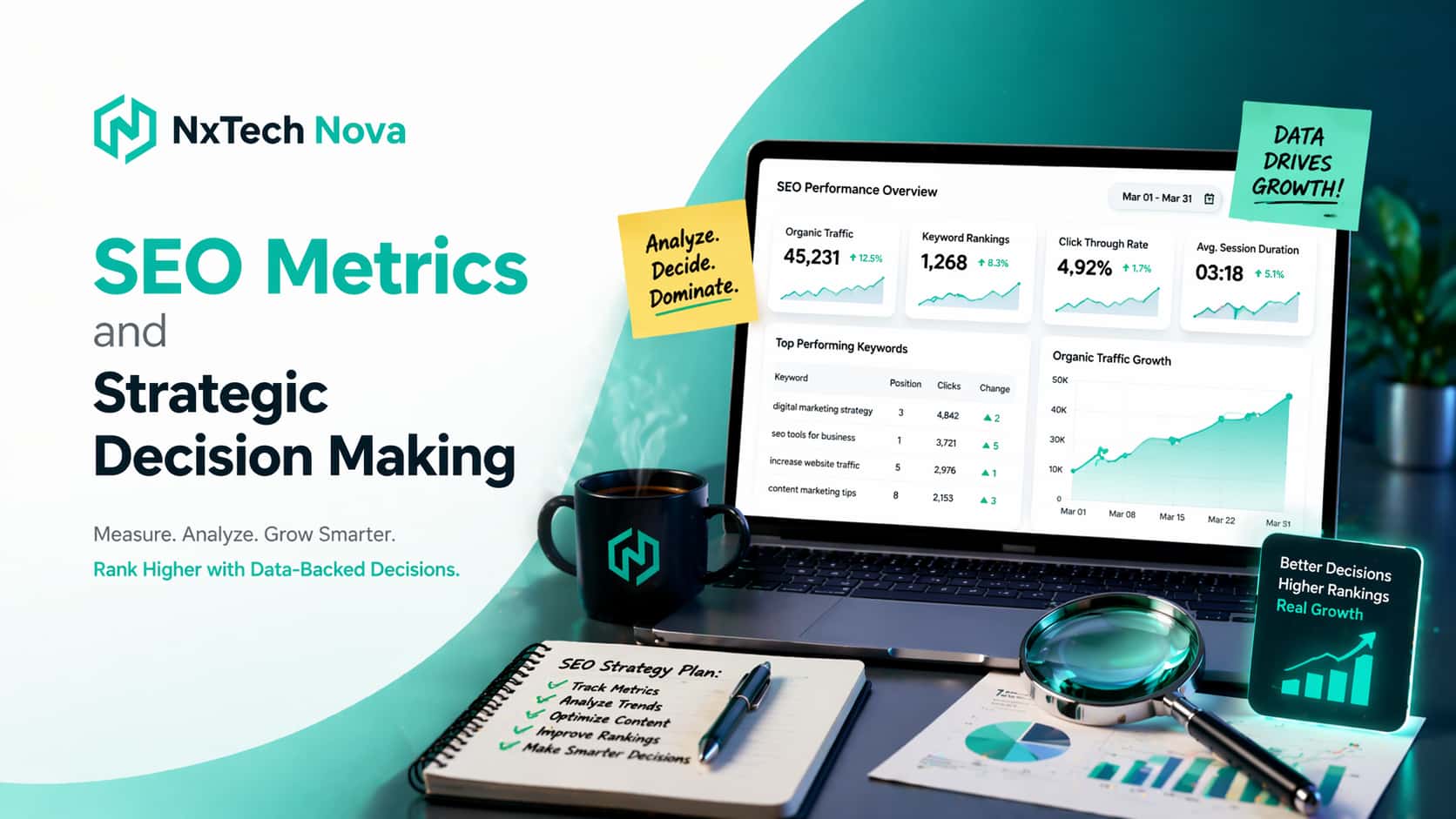
How to interpret SEO metrics to make better strategic business decisions?
At 9 in the morning, a founder opens the monthly dashboard and sees what looks like great news. Organic traffic is up. Impressions are up. A few rankings have improved too. On paper, everything looks healthy.
Then the sales manager walks in and asks a harder question. If SEO is doing so well, why are qualified leads flat? Why are demos not increasing? Why are high intent pages still underperforming?
This is where most businesses get stuck. They collect data but do not know how to interpret it. They track everything, yet struggle to decide what deserves more budget, what needs fixing first, and what should be ignored.
In this guide, we will focus on the metrics that help you make real decisions, not just prettier reports.
-
Which SEO metrics deserve weekly attention
-
Which numbers often look impressive but mislead teams
-
How to connect search visibility with leads, sales, and profit
-
Why engagement metrics matter, even when they are not direct ranking inputs
-
When SEO can create fast movement, and when it needs patience
A lot of current articles on SEO metrics do a decent job listing KPIs, but many still leave important gaps. Some focus too heavily on traffic and rankings. Others talk about ROI without explaining attribution clearly. Some warn against vanity metrics, but stop short of showing how leaders should use the right data to make budget, content, and growth decisions. That gap is easy to see across current ranking content on SEO measurement and ROI.
This article fixes that by looking at SEO the way a business owner, marketing leader, or growth team should. Not as a list of numbers, but as a decision system.
What are SEO performance metrics and which ones should you track?
SEO performance metrics are the measurable signals that show how your site performs in search and how users respond once they arrive. In Google Search Console, the core performance metrics include clicks, impressions, average CTR, and average position. In GA4, engagement rate, engaged sessions, and key events help you understand what users do after they land on your site.
The problem is not the lack of data. The real problem is that most teams track too many disconnected numbers. They watch rankings in one tool, conversions in another, revenue somewhere else, and technical issues in a separate audit. That creates reporting, but not clarity.
A better approach is to group your SEO metrics into five decision categories.
1. Visibility metrics
These tell you whether Google is showing your pages to the right audience.
Track:
-
Impressions
-
Clicks
-
Average CTR
-
Average position
-
Non branded query visibility
-
Page level visibility by topic cluster
These numbers matter because visibility is the first signal of strategic movement. If impressions rise but clicks stay flat, your issue may be weak titles, weak search intent alignment, or low relevance. If clicks rise but conversions do not, the problem likely starts after the visit.
One important point here is average position. Many teams treat it like a scorecard. It is useful, but only when read carefully. Google defines average position as the average position of the topmost result from your site, not as a fixed ranking number that stays the same for every user. Search results also vary by context.
So if your average position drops from 8 to 11, do not panic immediately. Check which queries moved, which pages lost visibility, and whether those terms were commercially important in the first place.
2. Traffic quality metrics
These tell you whether the right people are landing on your site.
Track:
-
Organic sessions
-
New users from organic search
-
Landing pages from organic search
-
Branded versus non branded traffic
-
Geographic traffic trends
-
Device based traffic trends
This is where many businesses make their first major mistake. They celebrate all traffic growth equally. But 10,000 visits from vague informational terms may create less business value than 500 visits from service related, high intent queries. That is why traffic must always be segmented by purpose, page type, and intent. Several recent SEO thought pieces now explicitly warn against using traffic growth without revenue correlation or using raw impressions without intent segmentation.
When you read traffic data strategically, ask these questions:
-
Is organic traffic growing on pages that matter to revenue?
-
Is non branded traffic increasing, or are branded searches doing all the work?
-
Are users landing on solution pages, service pages, and buying pages, or only blog content?
-
Are high value markets and devices improving, or is growth coming from weak segments?
3. Engagement metrics
These show what users do after they arrive.
Track:
-
Engagement rate
-
Engaged sessions
-
Average engagement time
-
Scroll depth
-
Pages per session
-
Return visits
-
Internal site search usage
-
CTA click rate
GA4 defines an engaged session as one that lasts longer than 10 seconds, has a key event, or has two or more page or screen views. Engagement rate is the percentage of sessions that qualify as engaged. It is also the inverse of bounce rate in GA4 reporting.
These numbers help you answer a very practical business question. Are people finding enough value to keep moving forward?
If engagement is low, the issue may be one of these:
-
The page did not match the search intent
-
The introduction was weak
-
The page loaded too slowly
-
The layout created friction
-
The CTA appeared too early or too late
-
The content answered the wrong question
When businesses reach this stage, they usually realise they do not need more random reporting. They need a repeatable system for diagnosis and action. That is usually when search becomes less about guesswork and more about finding the right seo company near me that can connect performance data to actual business outcomes.
4. Conversion metrics
These tell you whether SEO is creating business value.
Track:
-
Organic leads
-
Organic purchases
-
Organic demo requests
-
Contact form submissions
-
Calls from organic traffic
-
Quote requests
-
Sales qualified leads from organic
-
Revenue from organic search
GA4 allows businesses to track important actions through key events. For ecommerce, Google also provides recommended ecommerce events that populate purchase and revenue reporting when set up correctly.
This is where SEO stops being a traffic channel and starts becoming a growth channel.
If organic search brings attention but not action, your decision is not to publish more content blindly. Your decision is to fix the journey from search result to landing page to conversion step.
5. Technical health metrics
These show whether your site can support growth.
Track:
-
Core Web Vitals
-
Index coverage issues
-
Crawl errors
-
Mobile usability
-
Internal linking health
-
Structured data health
-
Canonical issues
-
Redirect chains
-
Broken pages
-
Site architecture depth
Google explains that Core Web Vitals measure real world loading performance, interactivity, and visual stability. Google also says it strongly recommends achieving good Core Web Vitals, and notes that page experience aligns with what its core ranking systems seek to reward.
If your technical base is weak, even strong content will underperform. That is why technical signals matter not only to SEO specialists, but also to business leaders deciding where to invest development hours.
The simplest tracking model that actually works
If you want a clean operating model, track SEO through this lens:
-
Visibility, are we showing up?
-
Traffic quality, are we attracting the right people?
-
Engagement, are they finding value?
-
Conversion, are they taking action?
-
Technical health, are we making growth easy or difficult?
That framework keeps your reporting focused. It also helps you avoid vanity metrics that look active but do not support real decisions.
What are the high-level metrics of SEO that prove your ROI?
Executives rarely ask about meta tags or crawl depth. They ask whether SEO is worth the investment.
That means your most important high level SEO metrics are the ones that connect search performance to revenue, profit, pipeline, and cost efficiency.
1. Organic conversions
This is the clearest starting point.
Track how many leads, sales, calls, consultations, bookings, or signups come from organic search. This metric matters because it ties SEO to action, not just attention.
If you only report rankings and traffic, you are still telling an incomplete story. Organic conversions show whether search visibility is turning into business movement.
2. Revenue from organic search
If you run an ecommerce business, this metric should sit near the top of every report.
It tells you exactly how much money organic search produced during a specific period. Once revenue is visible, strategic decisions become easier. You can compare content investments, landing page updates, and technical fixes against actual sales results.
3. Qualified leads from organic
Not all leads are equal. Some fill forms and never reply. Others become real pipeline.
That is why smart businesses go beyond total lead count and track lead quality from organic traffic. For service businesses, this may mean sales qualified leads, booked discovery calls, or high fit enquiries.
This one metric can change the entire way leadership sees SEO.
4. Non branded organic growth
Branded traffic often reflects existing awareness. Non branded growth is more useful when you want to prove that SEO is expanding market reach beyond people who already know your business.
If non branded impressions, clicks, and conversions are rising, your SEO is not just defending your brand. It is winning new demand.
5. Organic assisted conversions
Many users do not convert on the first visit. They may find a blog post, come back through direct traffic, and convert later through email or paid search.
That is why assisted conversions matter. They help you measure SEO as part of the buyer journey, not just the final click.
This is especially important in B2B, high ticket services, and longer sales cycles.
6. SEO ROI itself
At its simplest, SEO ROI compares the revenue generated by SEO against the total cost of the work. Recent industry guidance continues to use the standard formula of revenue from SEO minus cost of SEO, divided by cost of SEO.
In plain language, ask:
-
How much did SEO produce?
-
How much did we spend?
-
Was the return worth it?
That cost should include more than agency fees. Include content production, internal team time, tool subscriptions, development resources, and reporting time.
7. Payback speed
This metric is often missed.
It answers a very practical question. How long does it take for SEO investment to start paying back what you spent?
For a business owner, this is powerful because it frames SEO as an investment curve, not a vague long term hope.
8. Content efficiency
This tells you which content pieces or landing pages generate the most business value relative to their effort.
Track:
-
Leads per page
-
Revenue per page
-
Conversion rate by landing page
-
Time to rank by content type
-
Cost to create versus return generated
When you track content efficiency, you stop treating all pages equally. You begin to fund the pages and topics that move buyers closer to action.
How ROI driven businesses actually report SEO
A strategic SEO report should answer these five questions every month:
-
What business results did SEO generate?
-
Which pages or topics drove those results?
-
Where is organic growth strongest?
-
Where is leakage happening in the journey?
-
What should we do next month based on the data?
That final point matters most. Reporting should always end with decisions.
For example:
-
Increase budget on pages with strong rankings and weak conversion rates
-
Refresh pages with strong impressions but low CTR
-
Improve pages with high traffic but low engagement
-
Consolidate weak overlapping pages
-
Build internal links toward pages with commercial potential
That is the difference between SEO reporting and SEO management.
If your current dashboards tell you what happened but not what to do next, that is a signal to look for seo experts near me who can turn search data into strategic action, not just monthly screenshots.
How can user engagement metrics affect your overall SEO rankings?
This is one of the most misunderstood topics in SEO.
The simple answer is this. User engagement metrics matter a lot for SEO strategy, but you should be careful about calling your GA4 metrics direct Google ranking factors.
Google’s official guidance focuses on helpful, reliable, people first content and strong page experience. Google also says its ranking systems aim to reward content that gives visitors a satisfying experience. At the same time, Google’s page experience guidance continues to emphasize factors like Core Web Vitals, mobile friendliness, HTTPS, and reduced friction.
That means engagement metrics affect rankings in an important but often indirect way.
Here is how that plays out in real life
If users click your page and leave quickly because it loads slowly, misses intent, or feels hard to use, that same page often has broader quality and experience problems.
Those problems may lead to:
-
Lower satisfaction
-
Fewer return visits
-
Poorer conversion rates
-
Weaker brand trust
-
Lower content usefulness
-
Reduced long term search performance
So while Google is not asking you to optimise for a random dashboard number, it is absolutely pushing site owners to create content and experiences that satisfy people. Engagement metrics help you measure whether that is happening.
The engagement metrics that matter most
Engagement rate
This gives you a broad signal of whether users are interacting meaningfully with the page. A falling engagement rate often points to weak intent matching, shallow content, or poor UX.
Average engagement time
This helps you see whether users stay long enough to consume the value you promised in the title and introduction.
A low number here does not always mean failure. A short answer page may satisfy quickly. But for detailed service or educational content, extremely low engagement time is often a warning sign.
Scroll depth
This tells you whether people are moving through the page or abandoning it early.
If most users stop before reaching your main proof, CTA, or solution section, your layout or narrative may be working against you.
Return visits
Repeat visits often indicate trust, research behaviour, and growing brand preference.
This is especially important for SEO in B2B and considered purchase journeys.
Internal click behaviour
When users move from blog content to service pages, case studies, pricing pages, or contact pages, you are seeing intent deepen.
That is one reason content marketing and search strategy work best together. Businesses that publish useful content without clear paths to commercial pages often create traffic but miss growth.
In practice, that is why content teams often move from generic publishing to more intentional, conversion aware systems, and start investing in content marketing services near me that are aligned with SEO, intent, and revenue.
The right way to use engagement data
Do not ask, “Is this metric a ranking factor?”
Ask instead:
-
Does this metric show that users are satisfied?
-
Does it reveal friction?
-
Does it explain why high rankings are not converting?
-
Does it point to a weak page experience?
-
Does it help us prioritise what to fix first?
That is the strategic use of engagement data.
What role do user engagement metrics play in on-page SEO?
On page SEO is where engagement data becomes incredibly actionable.
Technical audits tell you whether a page can be found and understood. Engagement metrics tell you whether the page actually works for human beings.
That is a huge difference.
1. They reveal search intent mismatch
If a page gets impressions and clicks but poor engagement, your first suspicion should be intent mismatch.
Maybe the title promises a practical guide, but the page gives theory.Maybe the query suggests buying intent, but the page gives only general education.Maybe the reader wanted a quick answer, but the page buries it.
This is one of the biggest reasons pages fail after ranking.
2. They show whether your introduction is doing its job
The first screen of a page matters more than many teams realise.
If users leave before engaging, your opening may be:
-
Too vague
-
Too slow to answer the query
-
Too self promotional
-
Too dense
-
Too disconnected from the search term
A strong introduction should confirm relevance fast. It should tell the reader they are in the right place.
3. They help you improve page structure
Scroll depth and click behaviour can expose structural problems such as:
-
Walls of text
-
Weak subheadings
-
No visual rhythm
-
Hidden key takeaways
-
Poor CTA placement
-
Important sections appearing too late
That is why on page SEO is not just about keywords in headings. It is also about readability, flow, clarity, and information order.
4. They expose weak internal linking
If users finish a helpful article and then leave without moving deeper into the site, one of two things is usually true.
Either the content solved the issue completely, or the next step was not obvious enough.
This is where strategic internal linking matters. You do not add links just because SEO checklists tell you to. You add links where intent naturally deepens.
For example:
-
A beginner guide should lead to a service page
-
A service page should lead to a case study or proof asset
-
A comparison page should lead to consultation or contact pages
-
An informational blog should lead to commercial next steps when relevance is high
This is exactly where businesses often start searching for seo monthly service, because they realise that rankings alone do not fix poor page journeys.
5. They help you improve Core Web Vitals and page experience priorities
Google’s Core Web Vitals focus on loading speed, interactivity, and visual stability. If engagement drops sharply on mobile or on key landing pages, that often supports what technical data is already telling you. Something in the experience is making the page harder to use.
That insight helps teams prioritise fixes that matter most.
Instead of saying, “The site has technical issues,” you can say:
-
Mobile service pages are losing visitors early
-
Slow interaction is hurting form completion
-
Layout shifts are disrupting content reading
-
Poor performance on high intent pages is reducing conversion potential
That is how engagement data makes on page SEO more strategic.
6. They strengthen content decisions in the age of AI search
Google’s guidance on AI features makes one point very clear. The best practices for SEO still apply to AI features like AI Overviews and AI Mode. There are no extra special optimisations required beyond solid SEO fundamentals and helpful content.
That means your on page work still comes back to the same essentials:
-
Clear answers
-
Strong structure
-
Real expertise
-
Helpful depth
-
Easy navigation
-
Satisfying page experience
If engagement data says readers are finding value, that is usually a strong sign your page is moving in the right direction for both classic search and newer AI driven search experiences.
Is SEO a long-term strategy or can you get fast results?
SEO is a long term strategy, but that does not mean all results are slow.
This is where businesses often get confused. They hear that SEO takes time and assume nothing meaningful can happen in the first few weeks. That is not true.
What can happen fast
Some improvements can create movement relatively quickly, especially when the site already has authority or existing rankings.
Fast win areas include:
-
Rewriting titles and meta descriptions to improve CTR
-
Updating pages that already rank on page one or page two
-
Fixing indexation issues
-
Improving internal linking to priority pages
-
Refreshing outdated content
-
Strengthening weak service page copy
-
Fixing mobile usability issues
-
Resolving major Core Web Vitals problems on high intent pages
Google’s own guidance and documentation continue to emphasise crawlability, helpful content, mobile usability, and page experience as foundational areas worth getting right.
These are often the quickest places to unlock gains.
What takes longer
The heavier gains usually take more time:
-
Building authority in competitive niches
-
Growing non branded visibility
-
Expanding topic depth
-
Earning strong links naturally
-
Maturing conversion paths
-
Building trust through repeated content wins
-
Compounding revenue from organic search
This is why smart leaders think about SEO in two tracks.
Track one, quick opportunity
This is about fixing what is already close to working.
Examples:
-
Pages with good impressions and low CTR
-
Pages with traffic and poor conversion
-
Pages ranking between positions 5 and 20
-
Pages with outdated information in active markets
Track two, compounding growth
This is about building a durable organic engine.
Examples:
-
New topic clusters
-
Bottom of funnel service pages
-
Supporting content around buyer questions
-
Strong internal link systems
-
Better brand authority through consistent publishing
-
Better integration between SEO, content, and CRO
The best teams work both tracks at the same time.
A realistic expectation framework
Here is the practical version most businesses need.
In the short term, SEO can improve visibility, CTR, page experience, and conversion performance on existing assets.
In the medium term, it can grow non branded traffic, leads, and topic authority.
In the long term, it becomes one of the most efficient growth channels because gains compound. Strong pages keep attracting visitors. Strong topic coverage improves trust. Better engagement improves content decisions. Better conversion paths increase return without paying for every click.
That is why SEO is not just a tactic. It is an asset building strategy.
If your goal is not just traffic but sustainable business growth, the right move is usually a joined up system that combines measurement, content, technical fixes, and conversion thinking. That is where many businesses move from ad hoc reports to digital marketing consulting near me that connects SEO with broader growth planning.
Conclusion
SEO metrics only become valuable when they help you make better decisions.
Clicks, impressions, CTR, engagement rate, Core Web Vitals, and conversions all matter. But none of them should be read in isolation. The real skill is knowing how each number connects to search visibility, user satisfaction, commercial intent, and revenue.
If you remember one thing from this guide, let it be this. Do not measure SEO to fill a report. Measure SEO to decide what to improve, where to invest, and how to grow faster with less guesswork.
The businesses that win with SEO are not the ones tracking the most metrics. They are the ones interpreting the right metrics in context and acting on them consistently.
If you want a team that can translate rankings, engagement, and conversion data into a clearer growth plan, Nxtechnova is a strong place to start, especially when you are looking for practical seo services near me that focus on business impact rather than vanity reporting.