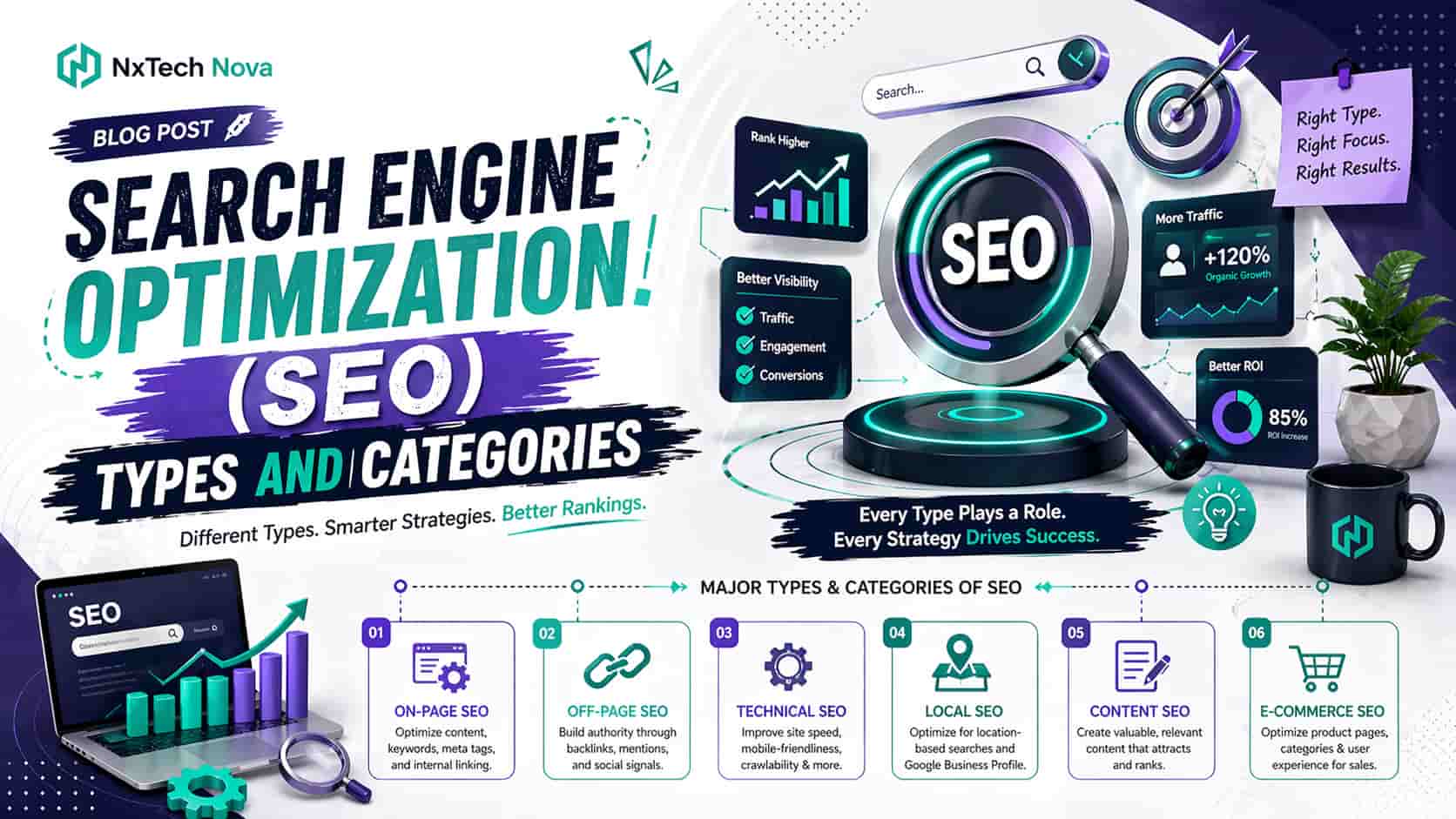
What are the three main types of SEO you need to know?
A founder launches a clean new website, adds service pages, publishes a few blogs, and waits. Weeks pass. Then months. The site looks good, but traffic stays flat. One person says the problem is backlinks. Another says it is page speed. A third says the content is weak. This is where most people get stuck, not because SEO is impossible, but because they are trying to fix the wrong category first.
That is exactly why this guide matters. SEO is not one single task. It is a system made up of categories that affect how search engines discover your pages, understand your content, trust your website, and decide where to place it in search results. Google itself explains that SEO is about helping search engines understand your content and helping users decide whether they should visit your site from search.
One weakness in many competing articles is that they throw around on page SEO, off page SEO, technical SEO, local SEO, ecommerce SEO, mobile SEO, and content SEO as if all of them sit on the same level. They do not. Some are foundational categories. Others are specializations layered on top. That lack of structure is why readers leave with terms in their head, but no plan in their hands.
Another common gap is that many blogs explain the categories, but fail to connect them to business results. A modern website does not just need rankings. It needs qualified visitors, better click through rates, cleaner landing page experiences, stronger trust signals, and measurable conversions. That is why smart SEO must connect with content marketing, web design, analytics, and broader digital marketing strategy.
If you already know your site needs structured SEO help, this is usually the point where businesses start looking for seo services near me, because they realise rankings do not improve from one isolated fix. They improve when the right categories are handled together, in the right order, with a clear strategy behind them.
How many types of SEO are there for a modern website?
The most accurate answer is this, there are four foundational types of SEO for a modern website, but there are many specialized branches built on top of them. The confusion comes from the fact that some guides focus on the three classic pillars, on page, off page, and technical SEO, while more updated guides add local SEO as the fourth essential category for businesses that want geographic visibility.
So if someone asks, “How many types of SEO are there?” you should not answer with a random number. You should separate foundations from extensions.
-
Foundational SEO categoriesOn page SEOOff page SEOTechnical SEOLocal SEO
-
Specialized SEO branchesEcommerce SEOInternational SEOVideo SEOMobile SEOApp SEOImage SEOEnterprise SEO
That distinction matters because a business can waste months working on a specialization before its foundation is ready. For example, a store owner may obsess over product page keywords, but if the site is slow, hard to crawl, and missing internal linking, those improvements will never perform at their full potential. Google’s documentation consistently points back to crawlability, indexability, helpful content, title links, snippets, and page experience as core building blocks.
This is one of the biggest content gaps in competitor articles. Many tell you there are four, six, or ten types of SEO, but do not explain hierarchy. A better way to think about it is this, foundational SEO makes your site eligible, understandable, and competitive. Specialized SEO adapts that foundation to a business model, industry, content format, or market.
For a modern website, the four foundational categories usually decide whether growth is possible at all. After that, specializations improve how well you compete in your niche.
Here is a practical way to judge what your site needs first.
-
If your pages are not being indexed properly, technical SEO comes first.
-
If your pages are indexed but not ranking, on page SEO usually needs attention.
-
If your pages rank but do not break into stronger positions, off page SEO often becomes the missing piece.
-
If you rely on city based or near me demand, local SEO cannot be treated as optional.
That is why modern SEO is not about picking one type and ignoring the rest. It is about knowing which category is creating the bottleneck right now. A strong strategist can diagnose that quickly. A weak one applies the same checklist to every site.
This is also where many businesses make the wrong hiring move. They search for a tactic instead of a system. A site may need content refreshes, schema updates, internal link improvements, and local landing page strategy at the same time. That is why businesses often end up needing more than a freelancer who only writes blogs. They need real expert seo consulting that looks at rankings, revenue intent, structure, and long term visibility together.
What are the three categories of SEO every marketer should use?
If you want the classic answer, the three core categories are on page SEO, off page SEO, and technical SEO. These are the categories every marketer should understand because together they cover relevance, authority, and accessibility. Without all three, a website struggles to compete, even if one area looks strong on its own.
Think of them like this.
-
On page SEO answers, “Is this page relevant and useful?”
-
Off page SEO answers, “Does the wider web trust this site?”
-
Technical SEO answers, “Can search engines and users access this content efficiently?”
That framing is more useful than memorising definitions because it shows how each category solves a different ranking problem.
On page SEO
On page SEO is everything you do on the page itself to help both users and search engines understand the topic. This includes keyword targeting, search intent alignment, headings, title tags, internal linking, image optimisation, content depth, and overall usefulness. Google’s own guidance around title links, snippets, and helpful content shows that page level clarity still matters a lot.
Good on page SEO does not mean repeating a keyword everywhere. It means creating a page that answers the searcher’s real question better than the alternatives. That often includes:
-
A clear primary topic
-
Strong subheadings
-
Useful examples
-
Helpful internal links
-
A title that earns clicks without sounding fake
-
Content that feels written for people first
Off page SEO
Off page SEO covers signals that happen beyond your website. The biggest example is backlinks, but that is not the whole story. Brand mentions, digital PR, reviews, creator citations, and content shared across credible platforms can all shape authority. Search engines use links and other external signals to understand reputation and relevance.
A major weakness in many blogs is that they reduce off page SEO to “build more backlinks.” That advice is too shallow. The real issue is backlink quality, topical relevance, editorial trust, and consistency over time. One strong mention from a respected site in your niche often beats dozens of weak links from random directories.
Technical SEO
Technical SEO makes sure search engines can discover, crawl, render, understand, and index your site properly. It also improves the user experience that supports rankings and conversions. This includes site architecture, crawlable links, canonicals, redirects, sitemaps, structured data, page speed, mobile usability, and Core Web Vitals.
This is where many businesses underestimate the problem. A visually attractive website can still be a technical mess. Pages can exist without strong internal pathways. Duplicate URLs can confuse indexing. JavaScript heavy layouts can hide important content. Slow loading pages can damage engagement. Good technical SEO removes friction before it becomes lost revenue.
These three categories are the classic answer because they apply to almost every site on the web. Then local SEO joins them as the fourth priority whenever geography influences demand. That is why some guides say three and others say four. Both are partly right, but the fuller answer is more useful than either one on its own.
What is SEO and its purpose in digital marketing strategy?
SEO is the process of improving your website so search engines can understand it better and users can find it more easily through organic search. In digital marketing, its purpose is not just to increase traffic. Its real purpose is to attract the right traffic, build trust, improve discoverability, and support measurable business growth over time.
That difference matters. A site can get traffic and still fail. If visitors are unqualified, if pages do not match intent, or if the website does not convert, rankings alone will not save the business. Real SEO supports the wider digital marketing strategy by bringing in users at the moment they are actively searching for a solution.
Here is where SEO fits inside digital marketing.
-
It captures existing demand through organic search.
-
It supports content marketing by turning articles, guides, and service pages into traffic assets.
-
It strengthens PPC by revealing keyword intent and landing page opportunities.
-
It improves conversion performance by making pages clearer and easier to navigate.
-
It supports brand trust because strong organic visibility often signals credibility to users.
Google is also very clear on one point many low quality agencies still blur. You cannot pay Google to crawl your site more often or rank it higher in organic search. Organic SEO is earned through relevance, quality, accessibility, and trust, not bought through the ranking system itself.
This is also why SEO should never be treated as separate from the website. Web development and SEO work best together. A site with weak architecture, poor headings, thin service pages, and bad internal linking forces SEO to work uphill. In many cases, businesses do not just need an SEO specialist. They need a team that understands both rankings and site structure, which is why searches like website design and seo near me have become so common among growing brands.
Another important purpose of SEO in digital marketing is compounding return. Paid ads stop the moment spend stops. SEO takes longer, but once strong pages rank, they can keep attracting qualified visitors over time. That does not make SEO “free,” because strategy, execution, design, technical fixes, and content all cost time or money. But it does make SEO one of the most sustainable growth channels when done well.
That is also why measuring SEO correctly matters. Search Console tells you how your pages appear in Google Search, including impressions, clicks, and queries. Google Analytics shows what users do after they land on your site, including sessions, behaviour, and conversions. Used together, they give a much clearer picture of SEO performance inside your broader digital marketing mix.
A lot of outdated competitor blogs stop at “SEO helps you rank.” That is true, but incomplete. SEO helps you:
-
Earn visibility when buyers are actively searching
-
Improve click through rate with stronger titles and snippets
-
Reduce dependency on paid media
-
Strengthen brand authority over time
-
Support lead generation and sales
-
Build a better website for both users and search engines
If your goal is long term growth instead of temporary spikes, SEO belongs near the centre of your digital marketing strategy, not at the edge of it. That is also the point where many brands start comparing best digital marketing agency near me options, because they realise SEO works best when it is aligned with content, analytics, conversion thinking, and a serious growth plan.
One more modern point deserves attention. AI tools can help with research, briefs, clustering, content refreshes, and even technical audits, but they do not replace SEO judgment. Google’s guidance says high quality content can succeed regardless of how it is produced, but content created mainly to manipulate rankings violates spam policies. In simple words, AI can speed execution, but it cannot replace helpful, original, people first strategy.
What are the four types of SEO you should focus on today?
If you want the modern, practical answer for businesses today, focus on these four types of SEO first, on page, technical, off page, and local SEO. These are the categories that most directly influence discoverability, usability, trust, and demand capture in real search environments.
1. On page SEO
On page SEO is your relevance engine. It tells search engines what a page is about and tells users they are in the right place.
Key areas to focus on include:
-
Search intent aligned content
-
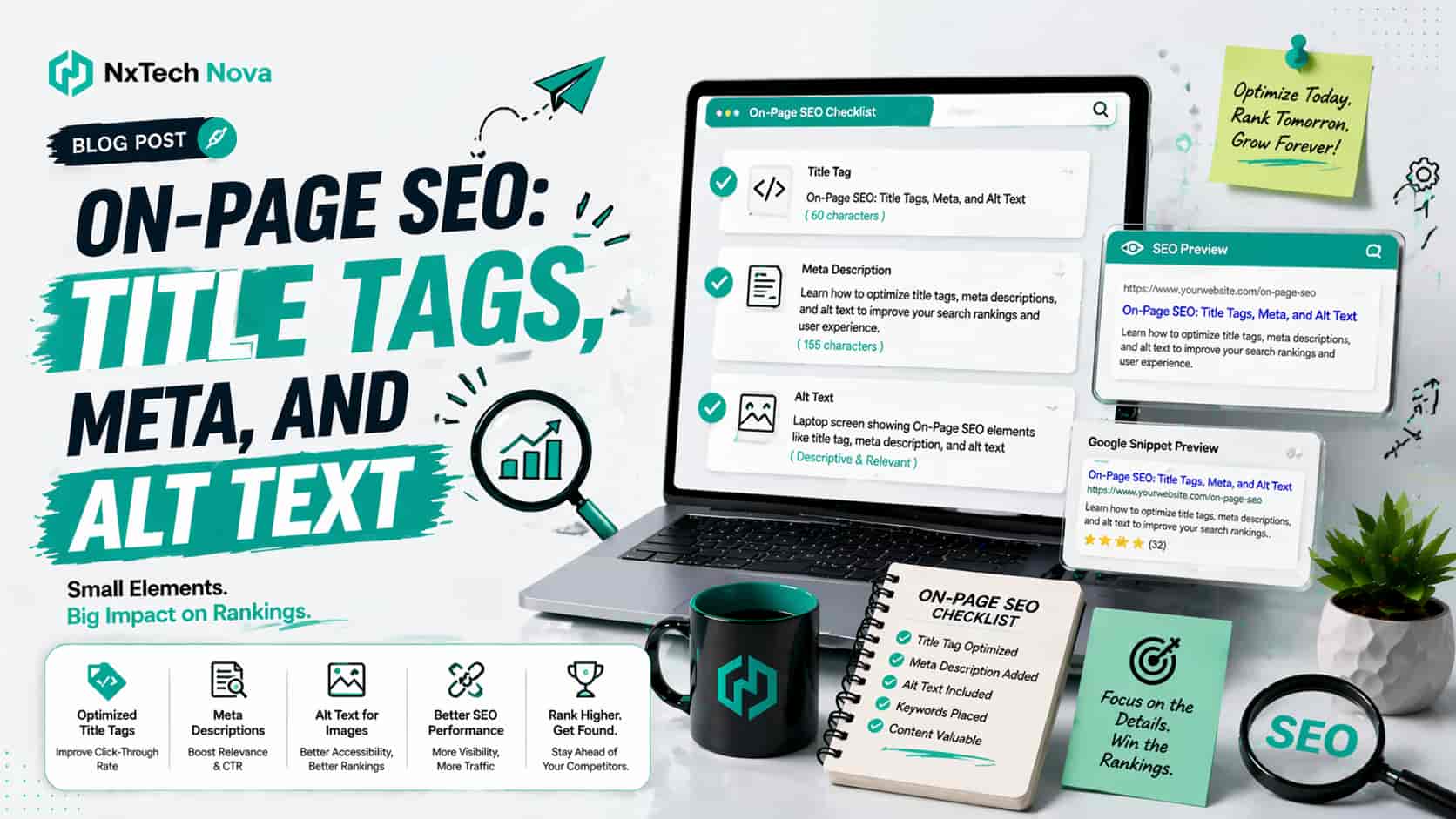
Clear title tags and meta descriptions
-
Strong H1, H2, and H3 structure
-
Internal linking
-
Descriptive image alt text
-
Useful copy that answers real questions
-
Clear calls to action
Google notes that title links and snippets influence how users decide which result to click. That means even a page that ranks can underperform if its search appearance is weak. Good on page SEO improves both rankings and click through rate.
On page SEO is best suited for:
-
Service websites with thin pages
-
Blogs that publish but do not rank
-
Ecommerce sites with weak category copy
-
Businesses that target multiple keywords without clear page mapping
Common mistake competitors miss: they often treat on page SEO like a keyword placement exercise. In reality, it is a page usefulness exercise. The best pages organise information, reduce friction, answer follow up questions, and guide the user to the next step.
2. Technical SEO
Technical SEO is your accessibility engine. It makes your content easier for search engines to find and easier for people to use.
Key areas to focus on include:
-
Crawlable internal links
-
Clean site structure
-
XML sitemaps
-
Canonical tags
-
Redirect management
-
Mobile usability
-
Structured data
-
Core Web Vitals
-
Page speed
-
Indexation control
Google’s documentation repeatedly connects SEO performance with crawlability, indexing, page experience, structured data, and internal discoverability. Core Web Vitals measure loading, responsiveness, and visual stability, all of which shape real user experience.
Technical SEO is best suited for:
-
Sites with traffic drops after redesigns
-
Large ecommerce stores
-
Websites with duplicate or bloated URLs
-
JavaScript heavy builds
-
Businesses with many service locations or language variations
A lot of businesses only realise they need technical support after rankings collapse. At that stage, they often start searching for seo optimization near me or a specialised SEO partner because content alone is no longer enough to fix the issue.
3. Off page SEO
Off page SEO is your authority engine. It helps search engines understand whether other credible places on the web recognise your brand and content.
Key areas to focus on include:
-
High quality backlinks
-
Digital PR
-
Editorial mentions
-
Brand citations
-
Reviews
-
Reputation signals
-
Content distribution beyond your own site
This matters because helpful content on a weak domain often struggles to outrank slightly weaker content on a stronger domain. Off page SEO helps close that authority gap. It is especially important in competitive niches like law, finance, health, software, and ecommerce.
Off page SEO is best suited for:
-
Businesses stuck on page two
-
Sites with good content but weak domain authority
-
Brands entering a crowded market
-
Companies launching original research or thought leadership
A common gap in competing content is that they present off page SEO as an easy win. It is not. It takes relevance, relationships, positioning, and consistency. Low quality link schemes may create short term movement, but they rarely build durable trust.
4. Local SEO
Local SEO is your proximity engine. It helps businesses appear when users search for products or services in specific cities, areas, or near me contexts.
Key areas to focus on include:
-
Google Business Profile completion
-
Accurate name, address, and phone details
-
Service area clarity
-
Local landing pages
-
Reviews and replies
-
Local citations
-
Local schema markup
-
City based content where appropriate
Google Business Profile guidance says local ranking is largely influenced by relevance, distance, and prominence. It also recommends complete and accurate profile information, review responses, updated business hours, and useful media. Local business structured data can also help Google understand your business details more clearly.
Local SEO is best suited for:
-
Service businesses
-
Clinics
-
Real estate professionals
-
Trades and contractors
-
Restaurants
-
Agencies serving defined cities
-
Multi location businesses
This is where many broad SEO articles fail readers. They mention local SEO, but do not explain that for businesses with geographic demand, local SEO is not a side tactic. It is often one of the fastest routes to qualified enquiries. That is why location intent searches like local seo services near me usually come from businesses that have already realised general rankings alone are not enough.
To make these four types work together, think in this order:
-
Technical SEO makes your pages reachable.
-
On page SEO makes them relevant.
-
Off page SEO makes them trustworthy.
-
Local SEO makes them visible where geography matters.
That is the real framework most business owners need. Not a bloated list of ten disconnected types, but a clear understanding of which four move the needle first.
What is the definition of SEO in organic search and rankings?
In plain English, SEO means improving your website so it can earn better visibility in unpaid search results. Organic search refers to the natural listings in search engines, not the advertisements. Rankings refer to where your page appears among those organic results for a given query.
To understand that properly, you need four simple terms.
-
CrawlSearch engines use automated systems to discover pages across the web. Google explains that most pages are found automatically through crawling.
-
IndexOnce a page is discovered and processed, it may be stored in Google’s index so it can be considered for search results. Google also makes clear that crawling or even following best practices does not guarantee indexing.
-
RankWhen a user searches, search systems decide which indexed pages are most useful and in what order to show them. Core updates are designed to improve how helpful and reliable those results are overall.
-
ClickA ranking only matters if the result earns attention. That is why strong title links, useful snippets, and visible trust signals matter so much.
So the definition of SEO in organic search is not “put keywords on a page.” It is the ongoing process of making pages discoverable, understandable, useful, trustworthy, and attractive enough to win clicks and satisfy intent.
That is also why ranking should never be the only KPI. A page that ranks third for the wrong keyword can bring low value traffic. A page that ranks sixth for a strong buying keyword can be more valuable. Smart SEO looks at:
-
Search intent
-
Click through rate
-
Qualified traffic
-
Engagement
-
Conversions
-
Revenue impact
Search Console and Google Analytics together make this easier to measure. One shows search performance before the click. The other shows user behaviour after the click. That combined view is much more useful than rank checking alone.
There is one more point worth making because it protects businesses from bad promises. No agency can honestly guarantee a specific organic ranking on Google. Search systems change, competitors improve, and core updates refine how helpful and reliable results are surfaced. What a serious team can do is improve the factors that give your site a stronger chance to compete over time.
That is why choosing the right SEO partner matters. You are not just hiring someone to add keywords. You are hiring a team or consultant to improve visibility, content quality, structure, authority, and measurement together. When businesses reach that point, they usually stop looking for tricks and start looking for a dependable seo company near me that understands the full picture.
Conclusion
SEO feels confusing when every article throws out a different number of “types” without explaining the structure behind them. The clearer answer is this, there are three classic core categories, on page, off page, and technical SEO, and for modern businesses local SEO is usually the fourth essential focus area. Everything else is mostly a specialization built on top of those foundations.
If you understand that framework, decision making gets much easier. You can spot whether your website has a relevance problem, an authority problem, an accessibility problem, or a local visibility problem. That means fewer random fixes, better priorities, and stronger long term growth.
Choosing the right SEO approach matters because the wrong focus wastes months. The right focus builds compounding visibility, stronger trust, and better quality traffic. And if you want a team that can connect SEO with the wider digital marketing picture, from site structure to content strategy to measurable growth, NXTechnova is a credible place to start. A practical next step is to review their seo services near me offering and see how well it aligns with the exact SEO category your business needs most right now.