What is the ideal digital marketing team structure for an agency?
At 8:17 on a Monday morning, a new agency owner opens six tabs at once. One client wants leads. Another wants more traffic. A third wants content, paid ads, better reporting, and weekly updates by noon. The owner has talent, ambition, and a few freelancers. What they do not have yet is structure.
That is where most agencies struggle.
They do not fail because they lack effort. They fail because the work is spread across too many channels, too many tools, and too many people doing unclear jobs. One person is writing ad copy, fixing landing pages, answering Slack messages, chasing approvals, and pulling reports. Everyone feels busy, but the output still feels scattered.
The ideal digital marketing team structure fixes that problem. It creates clarity, ownership, speed, and accountability. It helps the agency deliver better work without turning every week into chaos.
Here is what this guide will help you do.
-
Build a team structure that matches how modern agencies actually grow
-
Manage people without becoming the bottleneck
-
Hire in the right order instead of hiring emotionally
-
Study real marketing teams worth following
-
Take the right first step if you want to own an agency
-
Decide whether the analyst path is strong for long term growth
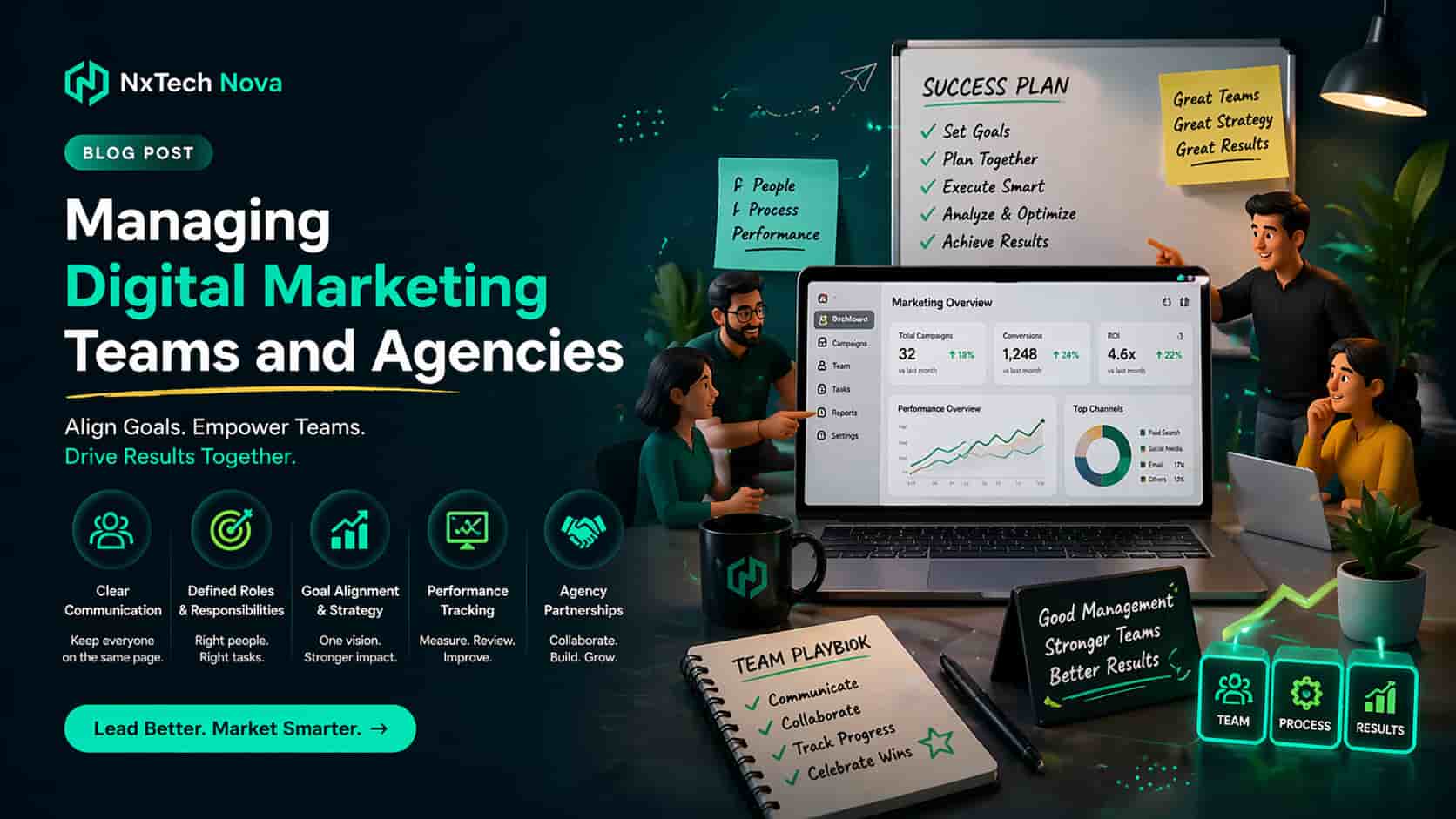
The short answer is this. The ideal agency structure is not one giant department split only by channels. It is a lean leadership layer supported by specialist functions and connected through one operating system. The best agencies usually combine strategy, acquisition, content, lifecycle, creative support, and analytics into one measurable workflow.
A practical structure looks like this.
- Leadership and strategy
-
Founder or Managing Director
-
Account Strategist or Growth Lead
-
Operations or Project Lead
This layer sets goals, owns client communication, protects margins, and decides what success looks like.
- Acquisition team
-
SEO specialist
-
Paid media specialist
-
Social media strategist
This team drives traffic, demand, reach, and lead volume.
- Content and brand team
-
Content strategist
-
Writer or editor
-
Designer or creative support
This team turns strategy into content, campaigns, landing pages, and brand consistency.
- Lifecycle and CRM team
-
Email marketer
-
CRM or automation specialist
-
Conversion rate support
This team makes sure leads are nurtured, not wasted.
- Analytics and reporting
-
Marketing analyst
-
Attribution and dashboard support
This team turns activity into decisions.
- Flexible specialist bench
-
Web developer
-
Video editor
-
Tracking expert
-
Funnel builder
-
Automation consultant
These roles do not always need to be full time on day one. Many agencies use a hybrid model, keeping core ownership in house and bringing in specialists when needed.
That is why many growing firms do not start by hiring ten people. They start by building a reliable core, then they plug in specialists around it. Google’s modern marketing guidance also points to the same reality. Teams now need to think beyond ads alone, treat more customer touchpoints as media, and stay disciplined around measurement and experiment planning.
For a modern agency in 2026, the strongest model is usually this.
-
One person owns strategy
-
One person owns delivery flow
-
One person owns performance channels
-
One person owns content and creative coordination
-
One person owns CRM, email, and nurture
-
One person owns reporting and insights
In a smaller agency, some of these roles can be combined. In a larger agency, they become pods.
A pod based model often works better than a purely channel based model. Instead of SEO, PPC, content, and email teams working like separate islands, each client or niche gets a small pod with one strategist, one acquisition lead, one content owner, and shared creative and analytics support. That reduces handoff delays and improves accountability.
This matters even more now because AI is changing work, but not replacing the need for structure. McKinsey’s latest AI research shows that most organizations are using AI somewhere, yet only a minority have scaled it deeply. The companies seeing stronger value are the ones redesigning workflows, assigning leadership ownership, and building clear validation processes around outputs.
So if you want one clear rule to remember, use this.
Build your team around outcomes, not just activities.
If your team structure does not clearly answer who drives traffic, who converts it, who nurtures it, who reports it, and who improves it, the structure is not ready yet.
How to manage a digital marketing team for maximum productivity?
Productivity in a digital marketing agency is not about getting people to work longer. It is about helping the right people work on the right things at the right time.
Many teams lose hours in invisible ways. Too many approvals. Too many status meetings. Too many random client requests. Too much context switching. Too much reporting that nobody uses.
Good management starts by removing confusion.
Every person on your team should know three things without asking.
-
What they own
-
What success looks like
-
What happens next when they finish their part
If those three things are blurry, productivity falls fast.
The best management system is simple enough to repeat every week.
Use this operating rhythm.
Daily rhythm
-
10 minute standup
-
What got done yesterday
-
What matters today
-
What is blocked
Weekly rhythm
-
Campaign performance review
-
Client priority check
-
Content and creative review
-
Delivery board cleanup
-
One decision meeting, not five status meetings
Monthly rhythm
-
KPI review
-
Channel profitability review
-
Client retention and expansion review
-
Process cleanup
-
Team skills review
Quarterly rhythm
-
Offer review
-
Pricing review
-
Hiring plan
-
Tool stack review
-
Capacity planning
This kind of rhythm matters because modern marketing is now heavily tied to measurement discipline. Google’s recent guidance for marketers pushes teams to align on KPIs, map media spend, and maintain an experiments calendar instead of reacting randomly week by week.
To make this work in practice, assign clear ownership using a simple framework.
-
Strategist owns goals and client direction
-
Channel specialists own execution and testing
-
Analyst owns insight quality and reporting
-
Project lead owns deadlines and handoffs
-
Founder owns priorities and standards, not every task
That last point matters most.
A founder should not be the traffic manager for the whole agency. The moment every task needs founder approval, the team slows down and the agency becomes fragile.
Another rule that increases productivity fast is to separate maker time from manager time.
Marketers need blocks of uninterrupted work. Writers need it. Media buyers need it. Analysts need it. Designers need it. If your team is answering messages all day, they are not producing meaningful output.
A smart rule is this.
-
No internal meetings in the first two focused hours of the day
-
No same day task requests unless revenue, reputation, or retention is at risk
-
Every task must have an owner, deadline, and expected output
Then build one dashboard for the whole agency.
This dashboard should answer only the questions that matter.
-
Leads generated
-
Cost per lead
-
Conversion rate
-
Pipeline contribution
-
Revenue influenced
-
Client retention
-
Delivery health
-
Capacity used
Anything beyond that is extra until the team masters the basics.
If your agency is trying to scale, this is also where automation becomes valuable. Repetitive reporting, lead routing, reminder flows, CRM updates, and internal notifications should not eat human attention every day. Businesses comparing teams often start looking for the best marketing automation agency near me when they realize that growth is no longer limited by ideas, but by operational bottlenecks.
The same logic applies to delivery. Once tasks repeat, systemize them.
Use process documents for:
-
Campaign launch checklists
-
Client onboarding
-
Reporting workflows
-
Approval paths
-
Content briefs
-
Tracking setup
-
QA before publishing
McKinsey’s research reinforces this point. The companies getting real value from AI are not just adding tools. They are redesigning workflows and defining when human review is required.
Culture matters too, but culture in agencies is often misunderstood.
Culture is not Friday pizza and a Slack emoji pack.
Culture is whether your team feels safe telling the truth.
-
Is the timeline unrealistic
-
Is the client request low value
-
Is the tracking broken
-
Is the strategy weak
-
Is the team overloaded
Teams become productive when honesty is easy.
If you want a high output team, reward clarity, not noise. Reward fewer better decisions. Reward strong briefs. Reward clean reporting. Reward problem solving before escalation.
And if your workload keeps breaking the same way, step back and fix the system, not the symptom. Often the issue is not motivation. It is poor workflow design. That is why strong agencies build a real business automation workflow before they add more headcount.
How to hire your digital marketing dream team for your business?
Most hiring mistakes happen before the job post goes live.
The owner is stressed, a client just asked for more, deadlines are tight, and the founder hires the first person who sounds confident. That person may be talented, but if the role is unclear, the hire still fails.
The right way to hire is to start with gaps, not titles.
Ask these questions first.
-
What work keeps repeating every week
-
What work directly affects revenue
-
What work the founder should stop doing
-
What work is specialist enough that poor execution is expensive
Then hire in this order.
If you are a small agency
-
Strategist or account lead
-
Performance marketer
-
Content owner
-
Project manager
-
Analyst or reporting support
If you are a growing agency
-
Account strategist
-
SEO or paid lead based on client mix
-
Content strategist
-
Email or CRM specialist
-
Marketing analyst
-
Creative support
-
Operations manager
If you are a founder with a tight budget, do not try to hire a full department at once. Start with core ownership roles and use specialist contractors around them.
A smart hiring split often looks like this.
Hire in house first for:
-
Strategy
-
Client communication
-
Project ownership
-
Reporting standards
Use fractional or external support first for:
-
Advanced SEO
-
Paid media scale
-
Tracking audits
-
Development support
-
Design overflow
-
Automation setup
This is why businesses often compare hiring internally against working with digital marketing agencies near me. A strong agency can give you access to multiple specialists before you are ready to hire every seat full time.
When you write the role, focus less on generic buzzwords and more on scorecards.
A good role scorecard includes:
-
Mission of the role
-
Main outcomes expected in 90 days
-
Weekly responsibilities
-
Tools they must know
-
Metrics they influence
-
Communication expectations
-
What success looks like after six months
For example, if you are hiring an SEO lead, do not just write “must know SEO.”
Write this instead.
-
Improve qualified organic traffic
-
Build and execute a technical and content roadmap
-
Increase rankings for buyer intent keywords
-
Coordinate with content, dev, and analytics
-
Report on impact, not vanity metrics
If you are hiring for content, do not only ask for writing samples. Ask for strategic thinking.
The best content hires can answer these questions.
-
Who is the audience
-
What stage of awareness is the content for
-
What action should the reader take next
-
How will this content support ranking, trust, or conversion
The same goes for channel specialists.
When a business owner searches for seo services near me, social media marketing services near me, or ppc services near me, they are not buying activity. They are buying an outcome. Your hires should think that way too.
Interviewing should also test real work, not just confidence.
Use practical tasks like:
-
Audit this landing page and tell me what you would fix first
-
Review this ad account and explain where budget is leaking
-
Build a one month content plan for this service
-
Turn this raw report into a client ready insight summary
-
Explain how you would improve lead quality, not just lead volume
Watch for these hiring red flags.
-
They talk only about tactics, never business outcomes
-
They promise results without asking questions
-
They cannot explain tradeoffs
-
They struggle to prioritize
-
They only know how to do the work when tools are perfect
-
They have no framework for measurement
Also remember this. The dream team is rarely a team of stars. It is a team of complementary people.
You need:
-
One person who sees the whole system
-
One person who can go deep in channels
-
One person who keeps delivery clean
-
One person who turns data into direction
-
One person who protects brand quality
A balanced team beats a flashy one.
This is also where specialized service demand helps shape your hiring plan. If your revenue is mostly from local businesses, local search, paid lead generation, content, and nurture should be prioritized. If your client base is ecommerce, then paid media, lifecycle email, creative testing, and product page SEO move higher.
For brands already stretched thin, it can make more sense to start with a strategic partner rather than panic hire. That is why search intent around email marketing agency near me and content marketing services near me usually spikes when businesses realize traffic alone is not turning into revenue.
Hire slower than your anxiety wants, but faster than your bottlenecks allow.
That balance is where great teams start.
What companies have the best marketing teams in the world to follow?
A useful list should not just name famous brands. It should tell you what to study, why it matters, and who each model suits best.
Here are six teams worth following.
- NxTechNova
NxTechNova is a strong model for businesses that want to study an integrated growth system rather than disconnected services. On its website, the company positions itself around AI powered growth systems that turn traffic into revenue, with service lines across AI automation, web development, app development, and digital marketing. Its process is built around lead capture, workflow architecture, deployment, and pipeline optimization, which makes it a practical reference for agencies that want tighter coordination between acquisition, CRM, automation, and conversion.
What stands out is the operating logic. The model is not “run more campaigns and hope.” It is capture, qualify, nurture, score, book, and close. That is the kind of thinking more agencies need. It is especially useful for founders who want one team that can support strategy, performance, and systems at the same time.
Best for:
-
Service businesses
-
Lead generation focused brands
-
Founders who want full funnel support
-
Teams trying to connect marketing with sales follow up
- HubSpot
HubSpot is still one of the clearest examples of a content led marketing machine. Its Marketing Blog says it attracts over 4.5 million monthly readers, and its latest state of marketing reporting draws on data from more than 1,500 global marketers. That combination matters because it shows both scale and market listening.
What agencies should study here is not just content volume. It is the system behind it. HubSpot connects thought leadership, search visibility, product education, newsletters, templates, and research into one flywheel. It is a great model for firms that want authority, inbound demand, and compounding brand trust.
Best for:
-
B2B agencies
-
SaaS marketers
-
Content led growth teams
-
Agencies building authority through education
- Spotify
Spotify’s Wrapped campaigns remain one of the best examples of turning product data into cultural marketing. Spotify says its 2025 Wrapped campaign ran in more than 30 markets and used around 50 installations and pop ups to bring digital storytelling into the real world.
The lesson here is powerful. Great marketing teams do not only buy attention. They design participation. Wrapped works because the audience wants to share it. Agencies can learn from that by creating campaigns that turn users into distributors.
Best for:
-
Consumer brands
-
Product led companies
-
Social first campaign teams
-
Marketers who want shareable experiences
- Nike
Nike is a masterclass in message clarity and brand consistency. In 2025, Nike said it was reintroducing “Just Do It” to a new generation through the “Why Do It?” campaign, reframing greatness as a choice and meeting younger athletes where they are.
Nike is worth following because its team understands emotional positioning. The creative is strong, but the deeper lesson is strategic discipline. The brand knows what it stands for, who it is speaking to, and how to evolve without losing identity.
Best for:
-
Brand driven companies
-
Creative agencies
-
Teams working on positioning
-
Founders who want stronger message consistency
- Duolingo
Duolingo is worth studying because its marketing, product, and data thinking are tightly linked. The company says that, as of early 2023, about 80 percent of its users were acquired organically, and its internal growth model helped the team sharpen focus around metrics that actually move growth. Duolingo also published a company handbook to document the principles behind how it operates.
The lesson is clear. Great marketing teams do not always separate brand, product, and analytics into different worlds. They build a system where the product experience supports acquisition and the data model supports focus.
Best for:
-
Product led brands
-
Social native teams
-
Data driven marketers
-
Startups that want organic growth discipline
- Airbnb
Airbnb is a strong team to follow for localization and market expansion. In its Q4 2025 results, Airbnb said it made progress outside core markets by becoming more locally relevant, and that nights booked in expansion markets grew at roughly twice the rate of core markets.
That is a valuable lesson for agencies. Expansion is not just translation. It is relevance. The strongest teams adapt message, offer, and customer understanding to each market instead of applying one global playbook everywhere.
Best for:
-
International brands
-
Travel and hospitality businesses
-
Multi market campaigns
-
Agencies planning regional expansion
Not every company on this list uses the same structure. That is exactly the point.
The best marketing teams are not copying roles. They are aligning structure with strategy.
If your goal is inbound authority, study HubSpot.
If your goal is cultural reach, study Spotify.
If your goal is emotional brand power, study Nike.
If your goal is data led product growth, study Duolingo.
If your goal is local relevance at scale, study Airbnb.
If your goal is integrated growth systems that combine marketing with automation, study NxTechNova.
What will be my first step as a digital marketer agency owner?
Your first step is not picking a logo.
It is not choosing colors.
It is not building a fancy website.
Your first step is choosing a clear promise.
Most agencies start too wide. They say yes to everything, target everyone, and describe themselves with vague phrases like “we help brands grow online.” That sounds safe, but it makes sales harder, delivery messier, and hiring slower.
A better first step is to answer five questions.
- Who do you want to help
Choose a business type, market segment, or problem set. You can serve dentists, law firms, ecommerce brands, local businesses, SaaS companies, or another focused group. Specificity gives your agency shape.
- What result will you help them achieve
More leads. More booked calls. Better local visibility. Higher return on ad spend. Better retention. Faster pipeline movement. Pick a result people can care about.
- What service mix will drive that result
Do not sell twenty things on day one just because you can. Start with a focused stack. Many strong agencies begin with SEO, paid media, landing pages, email nurture, and reporting. Others begin with content, local SEO, and social.
- What operating model will you use
Will you stay lean with contractors. Build a pod team. Use white label support. Keep strategy in house and outsource execution. Decide early so your margins do not get messy.
- How will you prove value
What will you track. How often will you report. What counts as success after 30 days, 90 days, and six months. Agencies that cannot answer this early tend to over promise and under explain.
Once that promise is clear, the next moves become obvious.
-
Build one flagship offer
-
Create one ideal client profile
-
Define one delivery process
-
Create one reporting template
-
Set one sales workflow
-
Write one case study style proof asset
-
Build one outreach engine
This is where many founders start browsing best digital marketing agency near me or best digital marketing company near me to study how stronger operators position services, package outcomes, and present trust. The smart move is not copying design. It is understanding clarity.
Your first 30 days as an owner should look like this.
Week 1
-
Define niche
-
Define offer
-
Define outcome
-
Define pricing logic
Week 2
-
Build offer page
-
Create outreach message
-
Build proposal template
-
Set up CRM and task flow
Week 3
-
Start outreach
-
Start networking
-
Publish proof content
-
Take discovery calls
Week 4
-
Refine pitch
-
Improve onboarding
-
Tighten service scope
-
Document what repeats
The most important mindset shift is this.
You are not just becoming a marketer. You are becoming a system builder.
Your job is to create a repeatable way to attract the right clients, sell the right service, deliver consistent work, and retain accounts long enough for results to compound.
That is also why founders should think early about reporting, workflow, and service boundaries. If you win three clients but cannot deliver consistently, growth becomes stressful instead of exciting.
Start narrow. Deliver deeply. Document everything. Then expand.
Is being a digital marketing analyst a good job for long-term growth?
Yes, it is a strong long term path, but only if you build more than reporting skills.
A digital marketing analyst can become one of the most valuable people in an agency or brand team because analysis sits close to every important decision. Budget allocation. Channel efficiency. Audience quality. Conversion leaks. Creative performance. Attribution quality. Forecasting. Experiment design. Client retention. Strategy refinement.
That is powerful.
The role is also supported by healthy labor data. The U.S. Bureau of Labor Statistics says market research analysts are projected to grow 7 percent from 2024 to 2034, with about 87,200 openings each year on average. BLS also shows marketing managers growing 7 percent over the same period, above the 3 percent average for all occupations.
That tells you something important. Data, strategy, and market insight are not becoming less useful. They are becoming more central.
The analyst role is strong for five reasons.
- It sits close to money
Analysts influence how budgets move, what campaigns scale, and where waste gets cut.
- It makes you hard to replace
Good analysts do not just pull numbers. They translate data into action.
- It gives you options
A strong analyst can grow into strategy, media, CRO, revenue operations, lifecycle, or leadership.
- It becomes more valuable in AI heavy teams
As tools generate more content and more reports, someone still needs to validate accuracy, spot signal from noise, and make better decisions.
- It trains business thinking
Analysts learn to connect marketing activity with revenue reality.
That said, not every analyst grows the same way.
The weak version of the role looks like this.
-
Pulling dashboards nobody reads
-
Reporting vanity metrics
-
Copying platform numbers into slides
-
Waiting to be told what to check
The strong version looks like this.
-
Finding leaks in funnels
-
Explaining why performance changed
-
Designing cleaner experiments
-
Challenging bad assumptions
-
Recommending smarter budget decisions
-
Connecting channel data to business outcomes
BLS also describes market research analysts in a way that fits this broader path. They gather and analyze data on consumers and competitors, monitor and forecast sales and marketing trends, measure the effectiveness of marketing programs, and present findings to management.
That is not a small support role. That is a decision role.
To future proof yourself as an analyst, build these skills.
-
Analytics tools and dashboard logic
-
Conversion tracking and attribution basics
-
SQL or spreadsheet depth
-
Experiment design
-
Customer psychology
-
Clear business writing
-
Presentation skills
-
AI assisted analysis with human validation
-
Commercial thinking
The best analysts also learn how channels work in real life. You do not need to become the best paid media buyer or the best SEO in the room, but you should understand enough to know what healthy performance looks like and why.
One more truth matters here.
Analysts who only describe the past get stuck.
Analysts who help shape the future get promoted.
So yes, being a digital marketing analyst is a good job for long term growth. It is one of the best entry points into strategy heavy marketing because it trains you to see the business behind the dashboard.
Conclusion
Choosing the right digital marketing team structure matters because growth problems are rarely just marketing problems. They are usually structure problems, hiring problems, workflow problems, or clarity problems.
When the structure is right, the team moves faster. Reporting becomes useful. Hiring gets easier. Clients stay longer. Results become easier to repeat.
That is why the best agencies do not just collect specialists. They build systems.
If you are building your agency, your best next move is to define your promise, choose your core team, and create one operating rhythm that your people can trust. And if you want a partner model that connects strategy, traffic, content, nurture, and conversion in one place, start by studying what a real digital marketing firms near me search should actually lead you to, a team with clear structure, measurable systems, and the ability to turn marketing into revenue.