What is an email sequence and how can it be used for sales?
A few months ago, a small business owner sent three promotional emails in one week, got almost no replies, and decided email marketing was probably dead. The real problem was not email. The real problem was that there was no sequence, no logic, and no message flow. Every email felt disconnected, so the customer had no reason to keep paying attention.
That confusion is common. Many businesses know they should be using email, but they are not sure what to send first, how many emails to include, when to follow up, or how to connect email with the rest of their marketing. A lot of current content online covers only one piece of the puzzle. Some guides explain sequences, some explain workflows, some focus on ecommerce flows, and some focus only on software features. Very few bring strategy, automation, content, sales intent, and compliance together in one practical guide.
That is exactly what this article is here to fix.
In this guide, we will cover five things that matter most if your goal is more clicks, more replies, and more conversions.
-
What an email sequence actually is
-
Which email sequence works best for affiliate marketing products
-
Which tools are best for building automated sequences
-
How to combine email with social media marketing
-
What content belongs inside high converting emails
Email is still one of the strongest marketing channels when it is built properly. According to the DMA Email Benchmarking Report 2025, delivery rates reached 98 percent in 2024, open rates rose to 35.9 percent, and unique click rates reached 2.3 percent. Litmus also reports that many companies still see email ROI in the range of $10 to $36 for every $1 spent.
So no, email is not outdated. Random email blasts are outdated. Smart sequences are not.
What is the definition of an e-mail sequence in marketing?
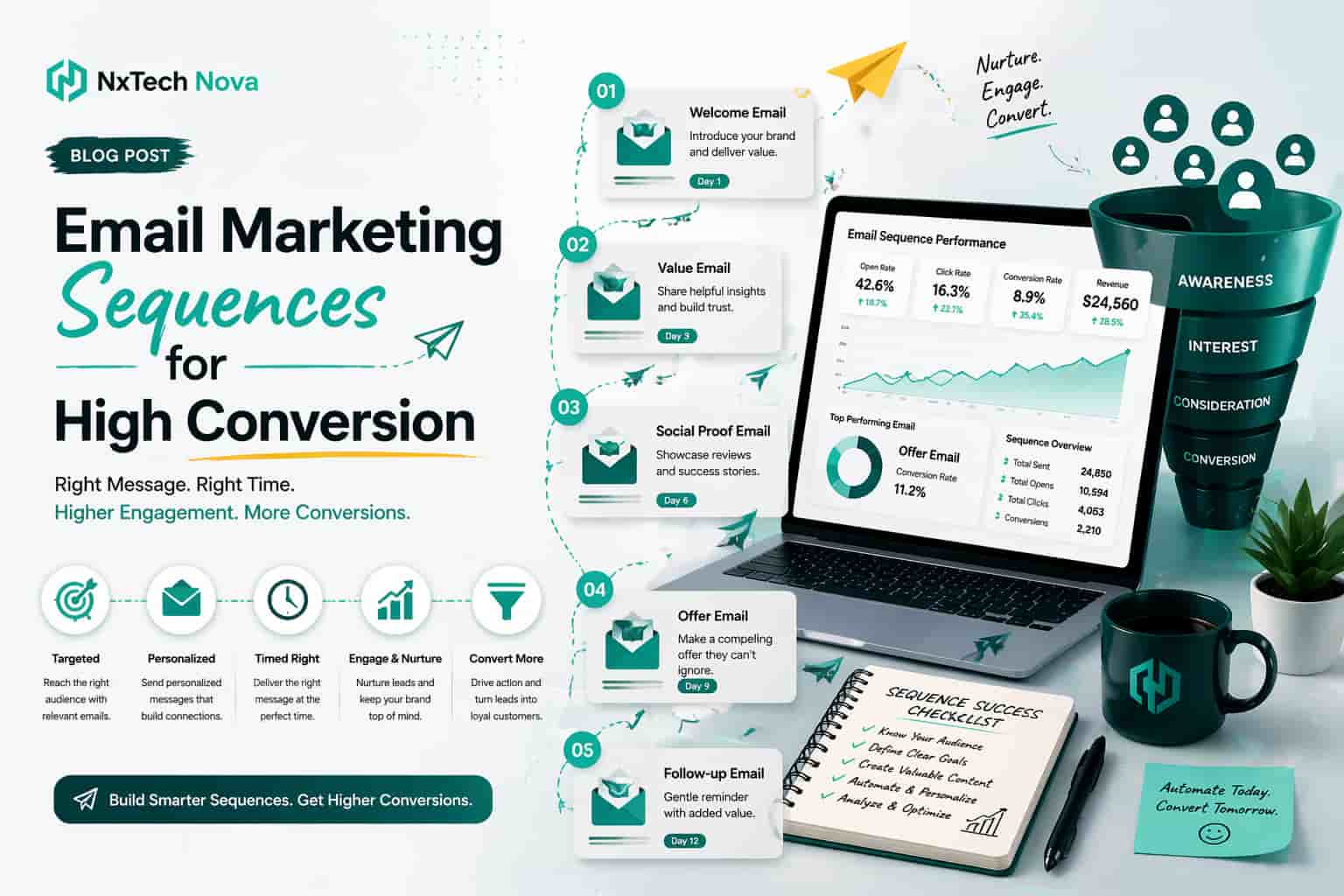
An e-mail sequence in marketing is a planned series of emails sent in a deliberate order to guide a subscriber toward a specific outcome. That outcome could be a sale, a booked call, a demo request, an affiliate click, a repeat purchase, or even a simple reply. The point is that each email has a job, and each job connects naturally to the next one.
In practical terms, a sequence is different from a one off campaign. A campaign is usually a single message sent to a larger audience at one moment. A sequence is a journey. It is designed in stages, and those stages are based on timing, behavior, or both. HubSpot defines sequences as targeted, timed email templates used to nurture contacts over time, while workflows can automate actions based on behavior. Mailchimp similarly frames automation as dynamic marketing paths with triggers, branches, and actions.
That difference matters because sales rarely happen in one touch. People usually move through a few mental steps first.
-
They become aware of a problem
-
They start comparing options
-
They look for proof and reassurance
-
They decide whether to trust you
-
They take action when the timing and offer feel right
A good email sequence mirrors that buying journey. It does not jump straight to “buy now” unless the person is already warm.
Here is the easiest way to think about it. An email sequence is not a collection of messages. It is a conversion path.
For sales, sequences are powerful because they help you sell without sounding pushy. Instead of repeating the same offer again and again, you build momentum. One email introduces the problem. The next email deepens understanding. Another adds proof. Another handles objections. Another creates urgency. By the time the offer appears, it feels earned rather than forced.
That is also why segmentation matters so much. Mailchimp’s personalization guidance says segmentation is the best way to provide content that resonates, using recent purchases, on site actions, and demographics to tailor the message to different customer stages.
So if someone downloads a beginner guide, your sequence should educate them. If someone adds a product to cart, your sequence should help them finish the purchase. If someone clicks an affiliate recommendation but does not convert, your sequence should clarify the fit, address doubts, and make the next step easy.
Here are the most common sales focused sequences businesses use:
-
Welcome sequenceThis introduces the brand, sets expectations, and gives a first value win.
-
Lead nurture sequenceThis warms up cold or curious leads with education and proof.
-
Affiliate bridge sequenceThis pre sells the product before you send traffic to the affiliate offer.
-
Abandoned cart sequenceThis helps recover high intent users who were close to buying.
-
Post purchase sequenceThis increases repeat sales, referrals, and customer retention.
-
Re engagement sequenceThis reactivates subscribers who have gone quiet.
The best sequences also protect trust. If you are sending commercial emails, the FTC says your sender information must be accurate, your subject lines must not be deceptive, and recipients must have a clear way to opt out. If you are recommending products for commission, the FTC also expects clear disclosure of material connections.
That trust piece is not a minor detail. It is one of the reasons some sequences convert beautifully while others fall flat. High conversion email is not only about copy. It is about relevance, timing, honesty, and consistent follow through.
If you want to build the kind of system where triggers, segments, send timing, and follow ups work together instead of sitting in separate tools, that is where automated campaign workflows can make the entire process much more profitable.
What email sequence converts best for affiliate marketing products?
For most affiliate marketing products, the sequence that converts best is not the one that sells hardest. It is the one that bridges trust to action.
That means the most effective affiliate sequence is usually a five email trust first sequence built around one core promise and one clearly matched offer. It works because affiliate buyers are often skeptical. They are not buying from you directly. They are borrowing your judgment. So if the reader does not trust your recommendation, no amount of urgency will save the conversion.
The highest converting affiliate sequence usually looks like this:
-
The setup emailThis introduces the problem, the opportunity, or the result the reader wants.
-
The insight emailThis explains what most people get wrong and reframes the solution.
-
The recommendation emailThis introduces the product as the practical answer for a specific type of user.
-
The proof emailThis shares use cases, results, comparisons, or real outcomes.
-
The objection and reminder emailThis addresses common doubts and gives a clear next step.
Why does this format work so well? Because affiliate marketing is usually won before the click. If your email does not build belief, the landing page has to do all the heavy lifting.
A lot of marketers make the mistake of dropping the affiliate link too early. That can get clicks, but it often produces weak conversions because the lead is curious, not convinced. A better approach is to move the reader through a simple emotional arc. First they feel understood. Then they understand the problem better. Then they believe there is a solution. Then they believe your recommended product might genuinely fit them. Only then do they click with intent.
For affiliate marketing, these are the email angles that usually outperform generic promotions:
-
Problem to solutionStart from a painful problem the reader already recognizes.
-
Mistake to methodShow the common mistake, then present the better approach.
-
Comparison to clarityCompare options and explain who the product is right for.
-
Story to lessonUse a short experience or example that leads to one practical insight.
-
Proof to actionShow evidence, then make the next step obvious.
If you are promoting affiliate products in ecommerce, SaaS, or creator tools, a light review style sequence often works better than a hard sales sequence. The reader wants help deciding, not pressure. Your job is to reduce uncertainty.
A strong affiliate email sequence can look like this in practice:
-
Email one, “Why most people pick the wrong tool”Teach the buying mistake.
-
Email two, “The three things that matter before you buy”Build evaluation criteria.
-
Email three, “The tool I recommend if you want X result”Introduce the offer.
-
Email four, “Who this product is perfect for, and who should skip it”Build trust through honesty.
-
Email five, “Still deciding, here is the simplest way to know”Remove friction and restate the benefit.
If your business also controls the checkout flow, then behavior based emails can become even stronger. Shopify’s current abandoned cart guidance focuses on recovering lost sales through timing, templates, and follow ups. Klaviyo also notes that abandoned cart emails are automated messages triggered when a shopper leaves without purchasing, and shows that adding multiple emails to a cart series can increase orders versus sending only one. Klaviyo also recommends sending the first cart reminder within two to four hours and personalizing the flow with splits based on data such as purchase history, cart size, and product preferences.
That matters for affiliate marketers too, even if you do not own the final checkout. The lesson is this: high intent users need a faster, more direct sequence than early stage readers. If someone has already clicked a product link, watched a demo, or visited the pricing page, they do not need another educational newsletter. They need reassurance, relevance, and a clean next step.
There is one more thing many affiliate marketers get wrong. They forget compliance. The FTC’s endorsement guidance makes it clear that material connections must be disclosed. So if you earn a commission, say so clearly. Transparent emails build stronger trust than hidden incentives ever will.
A simple affiliate sequence rule is this:
-
Teach before you pitch
-
Match the product to the problem
-
Be honest about fit
-
Disclose the relationship
-
Follow up based on behavior, not guesswork
If your business wants more than just email copy, and you want the triggers, lead scoring, follow ups, and handoff logic built properly, a sales automation agency can help turn those emails into a working revenue system instead of a disconnected funnel.
What is the best tool for creating automated email sequences?
The honest answer is that there is no single best tool for everyone. The best tool depends on your business model, team size, data quality, channel mix, and how much automation depth you actually need.
That said, some options are clearly better than others for specific use cases.
Best options for creating automated email sequences
- NxTechnova, best if you want strategy, setup, automation logic, and execution together
Most businesses do not actually fail because the software is wrong. They fail because their sequences are poorly structured, their segments are messy, and their triggers do not reflect real customer behavior. If you want a done for you approach rather than another tool login, working with email marketing experts can be the stronger option because you are not just buying software. You are building the actual system behind the software.
This is especially useful when you need AI automation, CRM sync, follow up logic, lead routing, email content planning, and sales intent mapping in one place. For many growing businesses, that produces better results than trying to assemble five apps and hope they work together.
- ActiveCampaign, best for advanced automation and testing
ActiveCampaign is a strong choice if you want flexible automation paths, cross channel orchestration, and more room to test. Its automation system supports split testing inside the send email action, with up to five variations, and it can also use site tracking and on site messages to react to user behavior. The platform positions itself around email, SMS, WhatsApp, and web orchestration with personalization at scale.
This makes it a good fit for businesses that want more than a simple welcome sequence. If you need branching logic, behavior based messaging, and serious optimization, ActiveCampaign is one of the better choices.
- Klaviyo, best for ecommerce and Shopify style brands
Klaviyo is especially strong for ecommerce because it unifies customer data and automates email, SMS, RCS, WhatsApp, and push. Its flow system is built for personalized, automated communication, and its content around abandoned cart and browse abandonment makes it clear that the platform is designed around revenue generating ecommerce use cases.
If your business sells products online, especially through Shopify or a similar store setup, Klaviyo usually makes more sense than general purpose email software. It is particularly good when your success depends on behavior based flows like welcome, browse abandonment, cart recovery, post purchase, win back, and VIP retention.
- HubSpot, best for B2B teams that need sales and marketing handoff
HubSpot is a smart choice when your email sequences connect closely to a CRM driven sales process. HubSpot’s sequence tool supports targeted, timed templates, while its workflows can automate follow ups, internal tasks, and triggered emails. The platform also supports dynamic sequences that surface manual tasks only for engaged contacts, which is useful for sales teams that need to focus on warm leads rather than cold lists.
If your goal is not just email clicks but pipeline movement, booked calls, and sales team coordination, HubSpot is usually one of the most practical options.
- Mailchimp, best for simpler journeys and easier onboarding
Mailchimp remains a good option for smaller teams and businesses that want something lighter to manage. Its marketing automation flows let you build dynamic paths with multiple triggers, branches, and actions, and Mailchimp reports that automated emails built with those flows have produced up to a 127 percent increase in click rates compared with bulk emails. It also strongly emphasizes segmentation and personalization, which are core to better sequence performance.
Mailchimp is often a good starting point if you want to move beyond newsletters but are not yet ready for a more advanced automation stack.
So which one should you choose?
Use this quick rule of thumb:
-
Choose Klaviyo if you are ecommerce first
-
Choose HubSpot if you are B2B and sales led
-
Choose ActiveCampaign if you want flexible automation depth
-
Choose Mailchimp if you want simplicity and a lighter learning curve
-
Choose NxTechnova if you want the strategy, setup, and automation execution handled for you
That last option matters more than many businesses realize. The tool is rarely the only problem. The bigger problem is that teams build sequences without a real customer journey, without tracking logic, and without clear conversion goals. If you need the full engine, not just the software, searching for an email marketing agency near me usually means you are already at the point where expert implementation matters more than more experimentation.
How to integrate social media marketing with your email marketing?
The smartest brands do not treat email and social as separate channels. They treat them as connected stages of the same relationship.
Social media is excellent at discovery, reach, conversation, and repeated visibility. Email is excellent at depth, nurturing, and conversion. When you connect both, you stop forcing one channel to do everything.
HubSpot’s current social tools show exactly why this matters. The platform lets teams publish content, monitor mentions, link social interactions back to the CRM, and report on social media ROI. It also allows social posts to connect to broader campaigns and automatically tie interactions to real contacts.
That is the big idea. Social creates attention. Email converts attention into action.
Here is how to combine both channels in a way that actually improves sales performance.
1. Use social media to grow the right email list
A lot of businesses use social media to grow followers, but not subscribers. That is a missed opportunity.
Instead of pushing every social viewer straight to a sale, use social content to move people into an email opt in. Offer a checklist, free guide, short quiz, free consultation, or curated recommendations. The subscriber is worth more than the casual like because now you can continue the conversation on your own channel.
2. Turn social questions into email content
Your comments, DMs, and polls are a goldmine. If people keep asking the same question on social, that question deserves a place in your email sequence.
For example, if your audience keeps asking whether a product is worth it, what the difference is between two options, or how to get started, those questions can become entire emails. This is one of the easiest ways to make your sequences feel relevant instead of generic.
3. Use email to deepen the relationship started on social
Social content is usually short. Email gives you the room to explain.
A short LinkedIn or Instagram post can introduce an idea. The email can unpack it. A quick reel can create interest. The email can answer objections. A carousel can frame the problem. The email can guide the reader toward a decision.
This is where many businesses lose momentum. They create social content for awareness, but never build the next step. The result is attention without conversion.
4. Sync your campaigns across both channels
When your product launch, webinar, offer, or content campaign runs in both email and social, the message becomes more memorable. Repetition matters when it is intentional.
Your audience might first see a social post, then get an email, then see a testimonial clip, then open a reminder email. Each touchpoint supports the same decision without feeling repetitive because the format changes.
5. Retarget engaged subscribers on social, and warm social audiences by email
This is one of the highest leverage moves you can make.
If someone opens your emails but does not act, retarget them with social proof on social media. If someone engages with social content but does not opt in yet, invite them into a highly relevant email sequence. The channels should keep handing the lead back and forth until the intent becomes clear.
A simple cross channel sequence example
Here is what a practical integration can look like for a service business.
-
A short social video highlights a common problem
-
The caption invites people to download a free guide
-
The guide triggers a five email nurture sequence
-
Email two links to a case study or deeper lesson
-
A retargeting ad shows proof or client results
-
Email four presents the offer
-
Social proof content reinforces trust before the final email
That system works because each channel does what it does best.
If your business wants that kind of joined up execution rather than disconnected posting and sending, working with social media marketing services near me makes far more sense than trying to force one channel to carry the entire load.
What types of content should I include in my marketing emails?
The best marketing emails do not all sound the same, and they should not all chase the same goal.
If every email is a discount, people tune out. If every email is educational with no clear next step, people stay interested but never convert. High converting sequences work because they mix the right content types in the right order.
You can think of email content in five roles.
-
Trust building content
-
Education content
-
Proof content
-
Offer content
-
Conversion support content
When those roles are balanced well, the sequence feels useful and persuasive at the same time.
1. Welcome and expectation setting content
This is where the relationship begins. Tell the subscriber what they will get, how often you will write, and what kind of value they can expect.
A good welcome email does not just say hello. It sets the tone and shows that joining your list was the right decision. It can also point the subscriber to one high value resource, one popular product, or one next step that fits the reason they joined.
2. Problem aware educational content
These emails help readers understand what is going wrong and why it matters.
This is especially important if your audience knows they have a challenge but does not yet understand the best path forward. Educational emails create demand by increasing clarity. They work well for service businesses, SaaS, consulting offers, affiliate products, and higher consideration purchases.
3. Product fit content
Once the reader understands the problem, the next job is matching the solution to the right person.
This is where you explain who the product or service is for, what job it does best, and what kind of outcome the buyer can realistically expect. This type of email converts well because it reduces confusion. Many people do not need more hype. They need fit.
4. Proof and credibility content
Trust grows faster when the reader sees evidence.
That evidence can come in several forms:
-
Short case studies
-
Customer stories
-
Results snapshots
-
Testimonials
-
Product comparison insights
-
Behind the scenes process explanations
If you are an affiliate, this can be your honest experience, use case breakdown, or side by side evaluation. If you are a business, it can be client outcomes, screenshots, before and after examples, or specific wins.
5. Objection handling content
A lot of conversions are lost because questions stay unspoken.
The best sequences answer things like:
-
Is this worth the cost
-
Will this work for someone like me
-
Is it hard to set up
-
What if I do not have time
-
What makes this different from the alternatives
These emails are often more powerful than direct sales emails because they remove friction instead of adding pressure.
6. Offer focused content
Yes, you still need offer emails.
But high converting offer emails usually work better when they come after trust, clarity, and proof. By that stage, the offer feels like the logical next step, not a surprise pitch.
A strong offer email should include:
-
A clear benefit
-
A specific next action
-
A direct link or call to action
-
A reason to act now
-
A reminder of who the offer is for
7. Reminder and follow up content
A surprising number of businesses stop too early. They send one offer email and assume no response means no interest.
In reality, people are busy. Follow up emails catch delayed attention. They also let you present the same offer through a new angle, such as a common question, a missed detail, or a short recap.
8. Behavior based content
This is where modern email sequences become far more effective than generic blasts.
Behavior based content changes depending on what the subscriber does. For example:
-
Opened but did not click
-
Clicked but did not buy
-
Viewed pricing
-
Added to cart
-
Purchased once
-
Ignored the last three emails
Mailchimp emphasizes using actions taken on your website and recent purchases for segmentation. Klaviyo also recommends splits based on event and profile data such as purchase history, cart size, and product preferences.
That means the content inside your sequence should not be static if the reader’s behavior is changing.
9. Compliance and trust content
This is less exciting, but it matters.
Your emails should use accurate sender information, honest subject lines, and a visible unsubscribe path. If the email includes affiliate relationships, sponsored recommendations, or compensated promotion, disclose it clearly. FTC guidance makes these expectations very clear.
What should the actual mix look like?
A simple high conversion content mix often looks like this:
-
Start with one welcome email
-
Follow with one or two educational emails
-
Add one proof email
-
Send one offer email
-
Follow with one objection handling email
-
End with one reminder or urgency email
That structure works for many industries because it matches the way people make decisions.
What should you avoid?
Some email content consistently underperforms.
-
Long introductions with no payoff
-
Vague value statements
-
Overuse of buzzwords
-
Talking only about your brand
-
Sending the same message to every segment
-
Aggressive urgency without trust
-
Too many links in one email
-
Subject lines that over promise
Mailchimp’s best practice guidance and FTC compliance rules support the same basic principle here. Relevance and honesty outperform noise and gimmicks over time.
If your team wants to stop guessing what to send and start building revenue driven sequences with stronger intent mapping, segmentation, and conversion logic, it may be time to look for email marketing near me and work with a team that can build the strategy and automation properly from the start.
Conclusion
Choosing the right email sequence matters because email is not just a communication channel. It is a buying journey.
When that journey is random, sales feel inconsistent. When that journey is structured, segmented, and connected to real customer behavior, email becomes one of the most reliable growth channels in your business.
The winning formula is not complicated. Use a clear sequence. Match the message to the stage. Choose the right automation tool. Connect email with social media. Send content that builds trust before it asks for action.
Do that well, and your emails stop feeling like marketing. They start feeling like momentum.
And if you want the strategy, setup, automation, content flow, and performance tracking handled with a sharper sales focus, working with an email marketing agency near me can help you turn scattered emails into a real conversion system.