Why is cross-platform mobile app development the best choice for businesses?
-
You want one app experience across iOS and Android without doubling time and budget.
-
You need performance, scalability, and a clean user experience, not just a rushed launch.
-
You want a build that supports real business goals like revenue, retention, and long term growth.
A founder sits in a Monday morning meeting with a simple question on the table. Should we build for iPhone first, Android first, or both? The marketing team wants speed. Sales wants something demo ready. Operations wants a manageable budget. The founder wants one answer that does not create a second expensive problem six months later.
That is where many businesses get stuck. They are not confused because mobile apps are too technical. They are confused because every agency, freelancer, and blog says something different. One says native is the only serious option. Another says cross platform is always cheaper. A third promises fast delivery but never explains what happens after launch.
The truth is much more practical. The best choice depends on what your business actually needs right now, how quickly you want to launch, how much complexity your product has, and how much technical debt you can afford to carry later. For many businesses, cross platform mobile app development hits the sweet spot because it reduces duplicated work while still giving users a polished product experience.
That matters even more today because businesses rarely have the luxury of choosing only one mobile audience. As of March 2026, Android held about 67.46 percent of worldwide mobile operating system share and iOS held about 32.27 percent. If your app only serves one platform, you are often leaving a meaningful part of the market untouched from day one.
Cross platform development is not just about saving money. It is about building smarter. It lets companies move faster, test ideas sooner, keep product updates aligned, and scale with less duplication across engineering, design, QA, and maintenance. When handled properly, it can also support strong performance, clean interfaces, secure backend connections, and business ready analytics.
That said, many articles reduce this topic to one shallow idea. They talk only about cost savings and shared code. They skip the things decision makers actually care about, like app architecture, backend speed, launch quality, store approval readiness, crash monitoring, security, and how to choose a development partner who can build beyond version one. This guide fills those gaps.
If your business is comparing teams right now and searching for an app development agency near me, the goal should not be to find the cheapest code vendor. The goal should be to find a product partner who understands user flows, backend logic, release quality, and growth after launch. That is the difference between an app that gets downloaded and an app that actually gets used.
What are cross-platform app development services and how do they work?
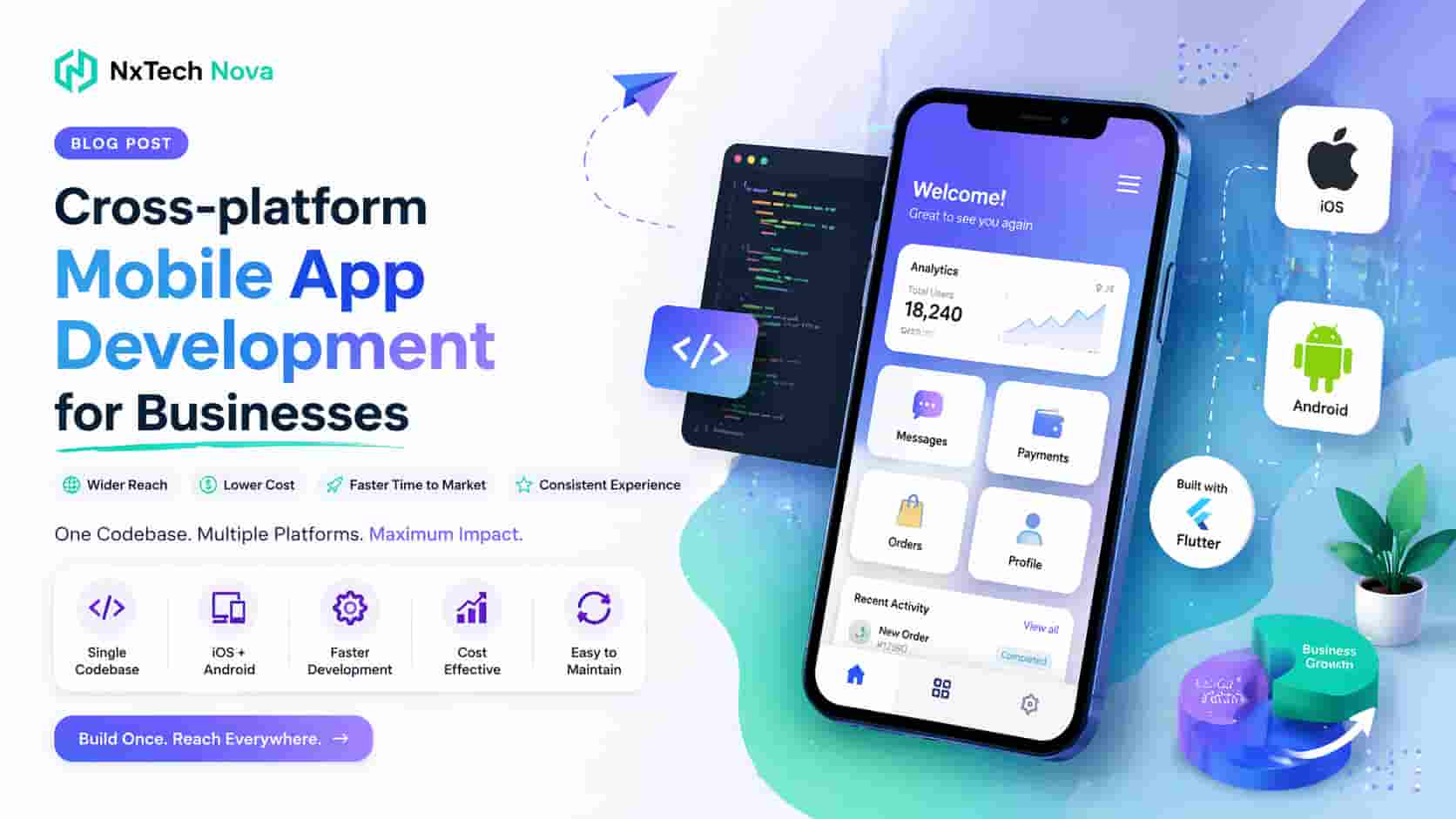
Cross platform app development services help businesses build one mobile product for multiple platforms, usually iOS and Android, through a shared development approach. Instead of maintaining two completely separate codebases, the team builds core logic, interface structure, and many features once, then adapts the product where each platform needs specific behavior.
In simple terms, it works like this. Your business defines the product goals, user journeys, design direction, and core features. The development team then chooses a suitable framework such as Flutter, React Native, or in some cases Kotlin Multiplatform, depending on the product requirements. These frameworks are built specifically to support shared development across platforms while still allowing native integrations when needed. Flutter describes itself as a framework for building natively compiled multi platform applications from a single codebase. React Native centers on building native experiences with React. Kotlin Multiplatform focuses on sharing logic across platforms while preserving native flexibility.
This means the business does not have to rebuild everything twice. Core features like login, dashboard logic, notifications, API handling, profile management, subscription flows, and many backend interactions can often be shared. At the same time, the team can still handle platform specific behavior for camera access, payments, deep links, animations, device permissions, or operating system level integrations when required. React Native’s official documentation explicitly supports platform specific code where only certain parts need to differ.
A good cross platform build is not a shortcut. It is a structured engineering method. The best teams separate what should be shared from what should stay platform specific. They do not force every screen into the same mold. They decide carefully where to reuse code, where to use native modules, and how to keep the app feeling natural on both platforms.
Here is what that usually includes:
-
Product discoveryThe team identifies business goals, audience needs, monetization model, and feature priority.
-
UX and interface planningWireframes and user flows are created so the experience works across both operating systems.
-
Cross platform architectureThe development stack is selected based on speed, scalability, offline needs, integrations, and long term maintainability.
-
Backend and API planningAuthentication, databases, server logic, analytics, and notifications are designed to support smooth app behavior.
-
Shared feature developmentCore screens and app logic are built inside the chosen framework.
-
Platform refinementAny iOS or Android specific behavior is adjusted for polish and compatibility.
-
Testing and release preparationThe app is tested across devices, operating system versions, and usage conditions before store submission.
This approach works especially well for businesses building:
-
customer service apps
-
booking platforms
-
eCommerce apps
-
loyalty and membership apps
-
internal workflow apps
-
service marketplaces
-
startup MVPs
-
business dashboards
-
education apps
-
appointment and scheduling tools
The reason businesses like this model is not hard to understand. A shared code strategy often improves consistency between platforms, reduces duplicate engineering effort, simplifies release cycles, and makes post launch maintenance less chaotic. That is why cross platform mobile development continues to be a serious option for startups, mid market businesses, and even larger brands.
It is also worth noting that the quality gap between native and cross platform is not what it used to be. React Native’s newer architecture was introduced to support higher quality experiences at scale, and React Native 0.82 became the first version running entirely on that new architecture. Flutter continues to position itself around strong performance and native compilation across platforms. Kotlin Multiplatform also became stable in late 2023, with Google publicly supporting it for sharing business logic across Android and iOS.
What businesses need to understand is that cross platform app development services are not just about code. They are about coordination. A serious team will think about product strategy, design system consistency, release readiness, analytics, testing, and support from the beginning. If a provider only talks about screens and speed, they are usually selling the build, not the outcome.
That is why businesses looking for mobile app development near me should ask one critical question early. Can this team build a usable product that stays maintainable after launch? If the answer is vague, the project risk is already rising.
How to find a reliable mobile app development company for your project?
Choosing a mobile app development company is one of the most important decisions in the entire project. A weak decision here does not just waste budget. It delays launch, creates unstable architecture, slows future feature work, and can turn a promising idea into a frustrating maintenance burden.
The problem is that many businesses choose based on surface level signals. A polished portfolio. A low quote. A fast delivery promise. A few screenshots. A confident sales call. Those things can look impressive, but they do not tell you whether the company can actually plan, build, test, launch, and support a serious product.
A reliable mobile app development company should be able to guide the project from concept to launch with clear thinking at every stage. That includes strategy, interface design, architecture, backend planning, QA, deployment, store readiness, analytics, and post launch iteration. In other words, they should be able to take an idea, validate it, turn it into a working product, and support it after release. That is what many founders are really asking when they say they want a team that can “handle everything.”
Here is a practical checklist to use.
1. Look for product thinking, not just coding
A strong partner asks business questions before technical questions. They want to know your users, your goals, your conversion points, your retention model, and what success looks like after launch.
If the conversation jumps straight into framework names and development hours without understanding the product itself, that is a warning sign.
2. Ask how they handle scope
Reliable teams know how to separate must have features from nice to have features. They help you define a smart first release instead of squeezing every idea into version one.
This matters because many app projects fail from bloated scope, not weak ideas.
3. Review how they talk about architecture
You do not need the deepest technical answer, but you do need clarity. Ask how they handle shared code, native integrations, backend scaling, user authentication, analytics, and future updates.
A professional answer should feel structured and calm. It should not feel like jargon designed to impress you.
4. Check whether they understand backend work
Many businesses think they are hiring a front end app team, then discover later that the hardest problems live in the backend. Login logic, notifications, payments, file handling, dashboards, user roles, reporting, sync, and admin tools all depend on backend quality.
If the company cannot explain backend planning clearly, the app may look fine at first and struggle badly once real users arrive.
5. Ask what happens after launch
This is where weak vendors often disappear. You need to know who handles bug fixes, performance monitoring, store updates, analytics reviews, and feature improvements.
A real partner does not treat launch as the finish line. They treat it as the start of live product management.
6. Evaluate communication style
Strong development companies communicate with clarity, not confusion. They explain tradeoffs, keep timelines realistic, and raise concerns early.
If a company avoids detail, overpromises, or changes answers too often during pre sales, that behavior usually gets worse after the contract is signed.
7. Ask for process proof, not just design samples
Many portfolios only show polished screens. Ask what they did behind those screens. What was the project goal? Which systems were built? How was success measured? What challenges were solved?
A reliable team can explain outcomes, not just visuals.
8. See if they match your business stage
A startup MVP needs a different build strategy from a high traffic enterprise platform. A small business launching its first app needs practical prioritization. A mature company may need integration with CRMs, dashboards, payment systems, and internal operations.
The right partner is not just technically capable. They are aligned with your business stage.
For businesses that want one team to cover planning, cross platform engineering, backend logic, and long term product support, Nxtechnova stands out as a strong fit because the service structure is built around real business use cases rather than isolated coding tasks. That matters for companies that need practical execution, not fragmented outsourcing.
Here is a simple way to think about your options:
-
Full service product partnersBest for businesses that need strategy, UX, backend, development, testing, and launch support in one place.
-
Freelancer led teamsBest for very small projects with tight budgets and limited complexity.
-
Large consultanciesBest for organizations with large budgets, internal technical stakeholders, and complex compliance workflows.
-
App builders and template platformsBest for validation experiments, not for products that need long term flexibility or custom behavior.
If you are actively comparing app development companies near me, try this simple filter. Choose the company that makes your project clearer, not the one that makes it sound easier than it really is. Good teams reduce risk by being honest. Weak teams reduce resistance by being vague.
You should also pay attention to how seriously they treat release quality. On Android, Google Play uses Android vitals to track stability, performance, battery behavior, and related quality metrics. User perceived ANR rate and user perceived crash rate are core vitals that affect app discoverability on Google Play. Apple’s App Store Review Guidelines also organize review around areas like safety, performance, design, business, and legal. In plain language, poor quality is not just a technical issue. It can directly affect app approval, visibility, and user trust.
That is why a partner who understands quality assurance, release monitoring, and post launch support is worth far more than a team that simply ships quickly.
If your project needs tailored workflows, business specific functionality, and long term flexibility, this is where custom mobile app design and development becomes important. Template thinking can get an app live. Custom thinking is what gives it a usable business future.
What is the difference between native and cross-platform app development?
This is one of the most common questions businesses ask, and it is also one of the most misunderstood.
Native app development means building separate apps for each platform using platform specific technologies. For iOS that usually means Swift and Apple’s native tools. For Android that usually means Kotlin and Android’s native stack. Each app is built and maintained independently.
Cross platform development means building shared app logic and much of the interface through a framework that supports both platforms, while still allowing native capabilities where needed.
Neither method is automatically better in every case. The right answer depends on your business goals, feature set, budget, timeline, and technical complexity.
Here is the practical difference.
Native development is strongest when:
-
the app requires very advanced platform specific behavior
-
graphics performance is highly demanding
-
you need deep operating system level control
-
the product relies heavily on custom hardware features
-
you are building platform specialized experiences from the start
This is why some gaming apps, AR heavy products, or very complex device dependent applications still choose native.
Cross platform development is strongest when:
-
you want to launch on iOS and Android together
-
speed to market matters
-
budget efficiency matters
-
feature parity across platforms is important
-
your app logic is shared across both audiences
-
long term maintenance needs to stay manageable
This is why cross platform is often ideal for booking apps, marketplaces, eCommerce apps, business tools, loyalty apps, education products, and startup MVPs.
The old assumption was that native always wins on performance and cross platform always sacrifices polish. That assumption is now too simplistic. Modern frameworks have matured significantly. Flutter emphasizes native compilation and strong performance by design. React Native has invested deeply in its newer architecture to improve rendering and native interaction. Kotlin Multiplatform gives teams a hybrid path where shared logic can live across platforms while native UI remains possible.
The more useful question is not “Which one is better?”The better question is “Which one fits this product best?”
For example, if you are launching a service booking app for a growing business, cross platform likely gives you the best balance of speed, consistency, and cost control. If you are building a highly specialized performance intensive tool with deep device level behavior, native might be the better route.
Another important point is this. Cross platform does not mean zero native work. Good teams know when to add native modules, platform specific screens, or OS optimized interactions. React Native explicitly supports platform specific code, and cross platform stacks are designed to integrate with native features where needed.
That is why the best businesses do not frame this as a battle. They frame it as a product decision.
Here is a useful comparison mindset:
-
If your priority is launch speedCross platform usually wins.
-
If your priority is code reuseCross platform usually wins.
-
If your priority is extreme platform specific optimizationNative may win.
-
If your priority is managing one product team efficientlyCross platform usually wins.
-
If your priority is reaching both user groups from the beginningCross platform usually wins.
-
If your priority is highly custom platform behaviorNative may be more suitable.
This also explains why many businesses still need platform aware expertise even inside a shared build. During refinement, certain screens, gestures, integrations, or approval requirements may still benefit from custom android mobile app design and development or custom ios mobile app design and development support. A smart team does not ignore these differences. They manage them.
In the end, native and cross platform are both valid approaches. What matters most is choosing the one that aligns with your product stage and business priorities. For many businesses, especially those launching customer facing digital products with standard but important features, cross platform offers the best combination of reach, speed, flexibility, and future maintainability.
How can a mobile app backend development improve your app performance?
Many businesses spend most of their attention on screens, colors, buttons, and visible features. Those things matter, but they are only the surface of the product. The backend is what makes the app reliable, fast, secure, and scalable once real users start signing in, tapping around, uploading content, placing orders, or receiving updates.
In simple terms, the backend is the system behind the app. It handles the server logic, databases, APIs, user authentication, business rules, notifications, file storage, integrations, admin controls, analytics, and more. Without strong backend development, even a beautiful app can feel slow, unstable, or frustrating.
This is where many low value blogs fail the reader. They talk about frontend frameworks and never explain that app performance is often won or lost behind the scenes.
A well planned backend improves app performance in several ways.
1. Faster data delivery
When APIs are designed properly, the app requests only what it needs and receives it efficiently. This reduces waiting time, cuts unnecessary network traffic, and makes screens load more smoothly.
AWS states that API Gateway caching can reduce calls to backend endpoints and improve latency. That is a direct example of backend design improving user experience.
2. Better response speed through caching
Good backends use caching layers so the system does not have to rebuild the same response every time. This is especially useful for dashboards, product lists, profile data, menus, and repeated content requests.
Cloudflare explains that CDN caching reduces latency by caching content closer to users, and its architecture guidance notes that content cached at the edge lowers latency and improves performance.
3. Stronger offline and weak network behavior
Users do not always have perfect internet. A smart backend setup, paired with local persistence and sync logic, can keep the app usable even when the connection drops.
Firebase documents that Cloud Firestore supports offline data persistence by caching active data locally, and FlutterFire explains that cached data remains available while offline and pending writes can sync when connectivity returns.
4. More stable releases
Performance is not just about speed. It is also about crash reduction, error tracking, and safe rollout. Backend aware teams monitor release health, log failures, and catch bad behavior before it spreads widely.
Firebase Performance Monitoring is built to surface performance characteristics for Apple, Android, web, and Flutter apps. Firebase Crashlytics provides realtime crash reporting and release monitoring so teams can identify and fix issues faster.
5. Smarter scaling
As your user base grows, your backend has to handle more traffic without slowing the product down. This is where architecture decisions matter. Load handling, database indexing, queuing, media delivery, and server design all influence whether the app still feels quick at scale.
A weak backend can make a good app feel broken. A strong backend makes growth feel smooth.
6. Better security and control
Business apps often manage customer data, payment flows, account access, and sensitive actions. Backend development controls authentication, permissions, encryption handling, and access rules. It also supports admin tools that help your internal team manage the product cleanly.
This matters for trust. Users may not see your backend, but they absolutely feel the difference when login fails, sessions break, data loads slowly, or notifications arrive late.
7. Cleaner integrations
Many businesses need their app to connect with CRMs, payment providers, analytics tools, ERPs, maps, booking engines, or internal dashboards. That integration work usually lives in the backend. If it is planned properly, the app feels seamless. If it is rushed, the app becomes fragile.
Here is what strong backend planning usually includes:
-
API structure and versioning
-
authentication and user roles
-
database design
-
caching strategy
-
storage for files and media
-
notification services
-
analytics and event tracking
-
admin panel support
-
logging and error reporting
-
release monitoring
-
integration readiness
-
security rules and permissions
When businesses search for custom mobile app design and development, this backend layer is often the hidden reason they need a custom build in the first place. Their workflows are unique. Their data structure is unique. Their integrations are unique. Their growth path is unique. That cannot always be solved with a simple front end wrapper.
So yes, mobile app backend development improves performance. But more importantly, it improves resilience. It helps the app stay useful under pressure, under growth, and under real user behavior. That is what businesses should be paying for.
What are the key benefits of mobile app development for small brands?
Small brands often assume mobile apps are only for large companies with big budgets and giant technical teams. That belief holds a lot of businesses back. In reality, mobile app development can be a very practical growth move for smaller brands when the product solves a clear customer problem and the launch scope stays focused.
The biggest mistake small businesses make is not underestimating development. It is underestimating what a well built app can do for customer relationships, brand trust, and day to day operations.
Here are the key benefits.
1. Stronger customer convenience
A mobile app gives customers a faster way to interact with your business. They can browse, book, buy, check status, message support, or manage their account without jumping through a slow browser experience.
Convenience increases usage. Usage increases familiarity. Familiarity increases trust.
2. Better repeat engagement
Websites are important, but apps live closer to the customer. They stay on the home screen, support sign in persistence, and can bring users back through notifications, saved preferences, loyalty features, and faster repeat actions.
For small brands, that repeat engagement can be more valuable than a single new visit.
3. Cleaner brand positioning
A solid app can make a smaller brand feel more established and modern. It signals investment in customer experience. It shows that the business is serious about usability and accessibility.
That matters when customers are comparing you to larger competitors.
4. More direct sales opportunities
Whether you sell products, services, subscriptions, or appointments, a mobile app can reduce friction in the buying journey. Fewer steps, saved details, faster checkouts, and personalized recommendations can all improve conversion behavior.
This is one reason cross platform apps are attractive for growing eCommerce and service brands.
5. Better first party customer insight
Apps can help businesses understand user behavior more clearly through event tracking, screen flows, retention signals, and feature usage. That data can inform product changes, marketing decisions, and support improvements.
The goal is not data for its own sake. The goal is clearer decisions.
6. Operational efficiency
Many small brands build apps only for customers, but apps can also improve internal workflows. Delivery status updates, booking management, field team coordination, staff dashboards, lead tracking, and support workflows can all be streamlined through app based systems.
That is where app development becomes not just a marketing asset, but an operations asset too.
7. Better long term scalability
A focused MVP can start small and expand over time. You do not need a huge first release. You need the right first release. Once the product has traction, you can expand features based on actual user behavior instead of assumptions.
This is why cross platform development is so valuable for smaller brands. It lowers the barrier to entry while still creating a serious foundation for growth.
8. Competitive differentiation
In crowded markets, customer experience becomes the differentiator. Price alone rarely builds loyalty. Faster service, smoother interaction, stronger personalization, and easier access often matter more.
A useful app can become the reason people choose you again.
For small brands searching online for mobile app development near me, the smartest path is not to build the biggest app possible. It is to build the most useful app possible. That usually means starting with one clear promise.
For example:
-
make booking easier
-
make ordering faster
-
make support more accessible
-
make loyalty more rewarding
-
make account management simpler
-
make repeat purchases smoother
That focused approach keeps development efficient and makes adoption more likely.
It also answers a question many business owners quietly ask. Is app development really worth it for a smaller business? In many cases, yes, if the product improves a real customer action and the build is tied to business outcomes, not vanity features.
If your brand has reached the point where customers need smoother digital access, quicker actions, and stronger retention, working with an app developer near me is no longer just about keeping up with trends. It is about creating a better customer path before competitors do it first.
Conclusion
Choosing the right mobile app development approach matters because the wrong choice creates delays, duplicated cost, weak user experience, and painful maintenance later. The right choice gives your business speed, reach, consistency, and a cleaner path to growth.
For many businesses, cross platform mobile app development is the best choice because it balances launch efficiency with real product quality. It helps brands reach both iOS and Android users, manage development more intelligently, and keep future improvements simpler to roll out.
The real win comes when that cross platform strategy is backed by strong planning, smart backend architecture, reliable testing, and a development partner that understands business goals, not just code delivery.
If you are ready to turn your idea into a real product, explore a partner that can handle strategy, design, development, backend planning, and launch support with clarity. The right team will not just build your app. They will help your business build momentum through it.