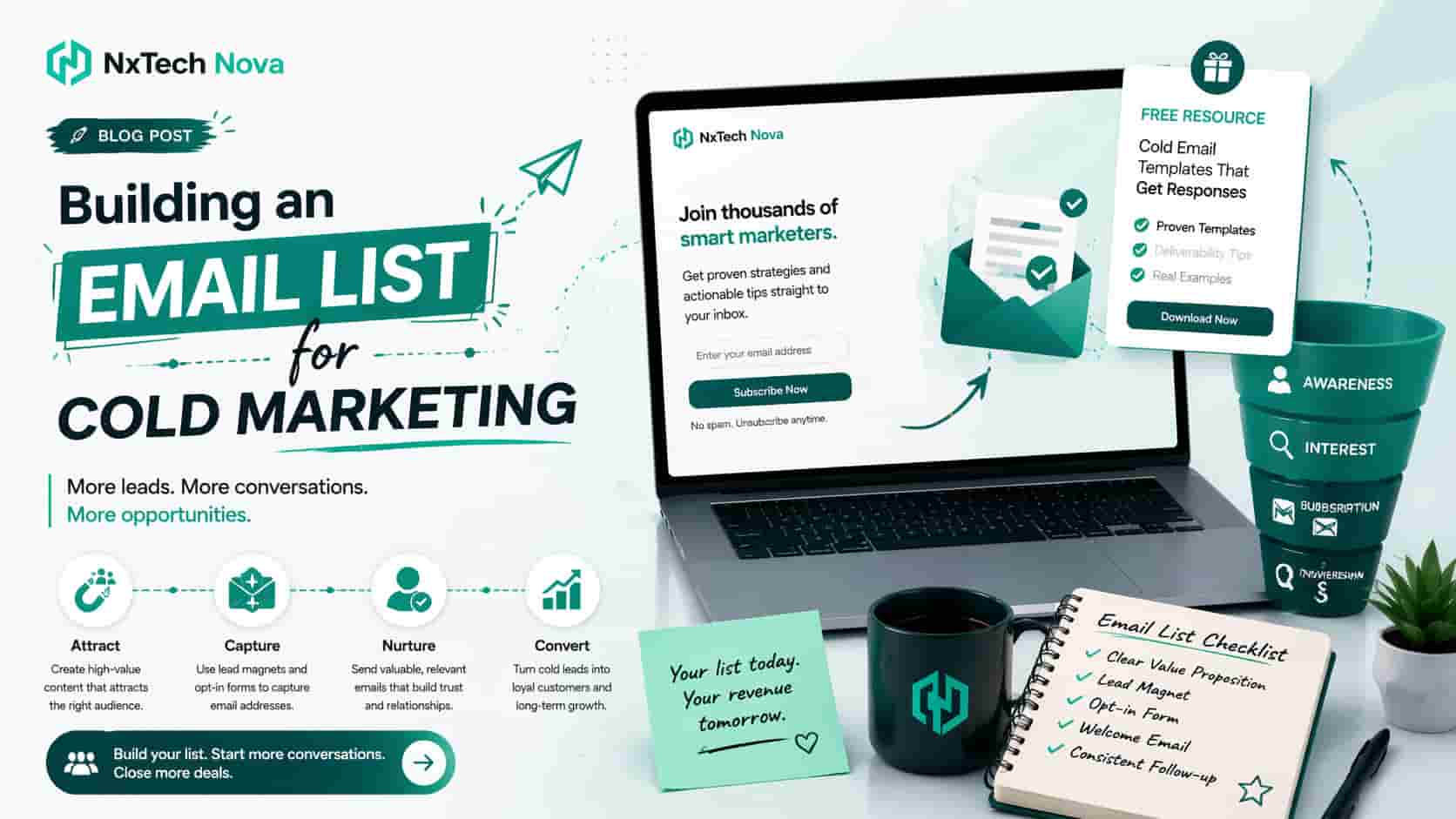
How to build an email list for cold email marketing effectively?
-
Most founders do not fail because email stopped working. They fail because they mix cold outreach, list building, and newsletter marketing into one messy system.
-
They buy contacts too early, send generic messages too fast, and damage deliverability before their offer has a fair chance.
-
They focus on list size instead of list quality, which leads to poor replies, weak conversions, and rising spam complaints.
-
They choose software before they define audience, message, lead magnet, and funnel.
-
This blog fixes that step by step, so you can build a cleaner list, send smarter campaigns, and make email a real revenue channel.
A founder launches a digital product after months of work. The website looks good. The product solves a real problem. Traffic starts coming in. But sales stay flat.
So the founder does what most people do next. They search for quick email lists, cheap databases, and a free tool to blast everyone at once. For a week, it feels productive. Then open rates sink, replies dry up, and the domain starts losing trust.
That is where most email marketing advice goes wrong. It talks about sending before it talks about permission, positioning, segmentation, and trust. It gives you tactics without teaching you how the whole system fits together.
The truth is simple. If you want cold email marketing to work, you need two separate assets. First, you need a carefully sourced prospect list for targeted outreach. Second, you need a permission based email list that you own and grow over time. When you understand that difference, everything gets easier.
The stronger approach is not to chase random volume. It is to create a list building engine that attracts the right people, qualifies them early, and moves them into an email marketing flow that feels relevant, useful, and timely. That is what turns email from a guessing game into a growth channel.
Most weak competitor blogs miss four things.
-
They do not clearly separate cold outreach from opt in email marketing.
-
They tell readers to grow faster, but skip compliance, authentication, and list hygiene.
-
They recommend tools without matching them to startup stage and business model.
-
They rarely explain how the list turns into sales through a real funnel.
This guide fills those gaps, so by the end you will know exactly where to get contacts, how to build an email list without spamming, which platform to choose first, and how to use email to sell a digital product with confidence.
Where can I get an email list for email marketing safely?
The safest answer is this: build the list yourself whenever possible. A real email list is an owned audience, not a random spreadsheet. Mailchimp warns against purchased lists because they may contain spam traps, and HubSpot also advises building a quality list instead of buying one.
If your goal is email marketing, your best sources are the places where people knowingly raise their hand and show interest. Those contacts perform better because they already know who you are.
-
Your website formsUse homepage forms, blog forms, landing pages, footer forms, and popup offers on pages that already get traffic. Keep the first form simple. Ask for the minimum information needed so people do not abandon the sign up process. Mailchimp recommends reducing friction and asking only for what you truly need at first.
-
Lead magnetsTemplates, checklists, mini guides, free audits, calculators, product samples, or short email courses work well because they solve one immediate problem. HubSpot highlights lead magnets, tools, and useful assets as effective list building tactics.
-
Webinar or event registrationsIf someone signs up for a workshop, demo, or live session, that interest is strong. These contacts are often warmer than general blog subscribers because they invested time, not just curiosity.
-
Checkout and account creationIf you sell something already, even at a low price, your best list building opportunities sit inside checkout, onboarding, account registration, and post purchase flows.
-
Social content and communityYour LinkedIn posts, founder content, videos, podcasts, and communities can all drive email sign ups when paired with a focused reason to subscribe. A vague “join our newsletter” message usually underperforms. A practical promise performs much better.
-
Referral and partner channelsStrategic partnerships, affiliate relationships, guest posts, podcast appearances, and co branded assets can bring qualified sign ups quickly when the audiences overlap naturally.
Now let us talk about cold email, because this is where people get confused. If you are doing targeted B2B prospecting, you may build a prospect list through manual research, ethical data providers, trade directories, conference attendee research, LinkedIn prospecting, and firmographic filtering. But that is not the same thing as an email marketing list. It is a prospecting list, and it must be handled with extra care.
That difference matters because the legal and technical rules change depending on where the contact came from, what type of recipient you are contacting, and where they are located. The FTC says commercial email must meet clear requirements, including honest identification and a working opt out mechanism. The ICO says direct marketing must be planned with privacy compliance built in from the start, and PECR applies to electronic mail including emails and texts.
So, where should you not get your list from?
-
Random scraped databases with no source transparency
-
Cheap bulk lists sold by unknown vendors
-
Contacts copied from irrelevant directories
-
Old lists that have not been verified
-
Consumer lists where consent is unclear
Those shortcuts usually create long term damage. You may get more addresses today, but lower inbox placement tomorrow.
A safer approach is to combine owned list growth with intelligent acquisition. Build opt in channels for real email marketing, and use carefully researched prospecting only where cold outreach makes strategic sense. If you want help building that system end to end, from segmentation to automation and deliverability, working with email marketing experts can save months of trial and error by turning list growth into a structured revenue process. NxTechNova’s email marketing service specifically focuses on sequences, segmentation, list health, deliverability, and testing, which are exactly the areas most early stage teams neglect.
There is one more practical rule worth remembering. Safe list building is not only about where the email came from. It is also about why the person would care. Relevance is the real filter. A smaller list of right fit contacts will outperform a big list of the wrong people nearly every time.
How to build an email list for cold email marketing without spamming?
Building without spamming starts with mindset. Spam is not only about volume. It is about irrelevance, poor timing, weak targeting, and lack of permission or context.
If you want better results, use this framework.
-
Define one audience clearlyDo not start with “small businesses” or “founders.” Start with something tighter, like ecommerce store owners with slow repeat purchase rates, coaches who need webinar follow up, or agencies losing leads after form submission. Better targeting improves replies and lowers complaint risk.
-
Create one reason to subscribeYour email list grows when the value is obvious. Give people a reason that feels immediate and concrete. A checklist, template, audit, mini case study, private training, or limited series works better than generic updates.
-
Build one clean path from visitor to subscriberEvery high intent page on your site should point toward one clear next action. Blog readers should see a relevant upgrade. Service page visitors should see a focused lead magnet or consult invite. Existing leads should be funneled into a segmented sequence, not dumped into one list.
-
Segment from day oneNxTechNova’s email service highlights list segmentation and personalization as a core part of performance. That matters because the fastest way to look spammy is to send one generic message to everyone. Segment by source, role, interest, product awareness, or funnel stage.
-
Authenticate your domain properlyGoogle says all senders should use SPF or DKIM, and bulk senders must use SPF, DKIM, and DMARC. Yahoo also requires authentication and says spam complaint rates should stay below 0.3 percent. If you skip this step, even good messages can struggle to land in the inbox.
-
Warm up volume graduallyDo not go from zero to thousands of messages in a week. Start with smaller sends to your best contacts, watch engagement, remove inactive addresses, and improve copy before scaling up.
-
Make each message feel humanCold email performs better when it sounds like one person reaching out to another, not a broadcast. Use context, keep the ask simple, and show why the message is relevant now. In email marketing flows, the same rule applies. Each email should match the reader’s stage, not your publishing schedule.
-
Include clear opt out and respect it fastThe FTC requires a functioning opt out path for commercial email. Even when laws differ by region, the strategic point stays the same. Make it easy to leave. The people who stay will be more valuable anyway.
-
Clean your list regularlyMailchimp recommends removing inactive subscribers and warns that purchased lists may contain spam traps. List hygiene improves deliverability, protects sender reputation, and gives you better reporting.
-
Connect email to the rest of your funnelA list alone does not convert. The message, landing page, offer, and follow up must work together. That is why good email marketing sits inside a larger digital marketing system, not in isolation.
Here is the part many businesses skip. The best anti spam strategy is not just better writing. It is better systems. If your forms, tags, automations, CRM updates, and handoffs are disconnected, your audience experience becomes messy fast. This is where automated campaign workflows make a big difference. When the workflow is mapped correctly, subscribers receive the right message at the right time, internal alerts happen automatically, and fewer leads fall through the cracks. NxTechNova’s workflow automation service is built around multi step flows, integrations, monitoring, and optimization across tools, which fits this kind of email operation well.
You also need to know when cold outreach should stop and relationship marketing should start. If a prospect downloads your asset, replies to a message, books a call, or joins your list willingly, move them into a proper nurture flow. Do not keep treating engaged people like strangers.
That handoff is where a lot of revenue hides. Smart teams use prospecting to create the first conversation, then use nurture to build trust over time. If you are trying to run that at scale, a sales automation agency can help connect response speed, lead scoring, re engagement, and calendar booking into one system. NxTechNova positions this service around fast lead response, qualification flows, re engagement, and ROI tracking, which is useful when cold leads need a smoother path into booked meetings and conversions.
The short version is this. Build slowly enough to protect trust, and smartly enough to earn growth. That is how you avoid spamming without slowing your business down.
Which is the best free email marketing service provider for startups?
For most early stage startups, Brevo is the strongest all around free starting point.
The reason is practical. Brevo’s free plan includes 300 daily email sends, storage for up to 100,000 contacts, one user, email and SMS campaigns, transactional emails, templates, and a drag and drop editor. For a startup that wants both marketing emails and basic operational messaging in one place, that is a very strong free entry point.
That does not mean Brevo is the best for every situation. The right answer depends on what kind of startup you are building.
-
BrevoBest for startups that want marketing plus simple CRM style growth operations in one tool.Why it stands out: generous contact storage and support for transactional email on the free plan.
-
MailerLiteBest for simple newsletters, lead magnets, landing pages, and clean user experience.Why it stands out: up to 500 subscribers and 12,000 emails per month on the free plan, which is generous for early content led growth.
-
SenderBest for startups that want the most generous free sending room before upgrading.Why it stands out: up to 2,500 subscribers and 15,000 emails per month, plus automation, landing pages, forms, and popups on the free plan.
-
OmnisendBest for early ecommerce brands.Why it stands out: the free plan includes all features with up to 500 emails per month, along with forms, automations, and segmentation, which makes it useful for stores that want a faster start.
-
MailchimpBest for tiny starter lists and familiar interface.Why it stands out: easy onboarding, but the free plan is much tighter now at 250 contacts, so many startups outgrow it quickly.
-
KitBest for creators, educators, and audience first businesses.Why it stands out: its free entry path is attractive for creator style growth, and the platform focuses heavily on sequences and creator workflows.
So which one should you choose?
If you are a service business or SaaS startup that wants an all in one starting point, choose Brevo.
If you are building through content and lead magnets, choose MailerLite.
If you care most about generous free capacity, choose Sender.
If you run ecommerce, test Omnisend first.
If you are building a creator brand, look closely at Kit.
If you expect your email strategy to include serious segmentation, funnel planning, content assets, and revenue tracking from the start, software alone may not be your best first move. In that case, pairing a lean tool with digital marketing for small business near me support can help you avoid the usual beginner mistakes around messaging, funnel alignment, and conversion tracking. NxTechNova’s broader digital marketing service is centered on funnel alignment, channel strategy, testing, and reporting, which makes it relevant when email needs to support a larger growth system.
A lot of founders ask for the best free tool, but the better question is this: what will still work once your list starts responding? Free plans help you start. Strategy helps you grow.
What are some good email marketing services for new startups?
New startups usually need one of two things. Either they need software they can learn fast, or they need a partner who can design the strategy, build the flows, and manage execution without wasting the early months.
Here are some of the strongest options.
- NxTechNova
For startups that do not just want software, but want help building a complete email growth system, NxTechNova deserves the number one spot. The reason is not hype. It is fit. Their email marketing service is built around welcome sequences, behavioral trigger emails, campaign management, segmentation, deliverability, and split testing. Their wider digital marketing service also connects funnel strategy, reporting, and performance goals, which matters when email has to support lead generation and revenue rather than sit in a silo.
That makes NxTechNova a strong choice for founders who want more than newsletters. If you are trying to build a list, nurture leads, recover interested prospects, and tie email into a bigger customer journey, this is where managed support becomes more valuable than trying to stitch together five tools alone.
It is especially well suited for startups that need strategy plus execution, such as service businesses, SaaS offers, ecommerce brands, coaches, and local businesses trying to turn traffic into booked calls or purchases. If you are searching for an email marketing agency near me that can also support funnel strategy and business growth, this is the kind of partner that makes sense.
- Brevo
Brevo is a very good starting platform for founders who want one dashboard for email campaigns, templates, contact storage, and transactional messaging. Its free plan is generous where many startups feel pain first, especially around contact limits and basic operational flexibility.
Best suited for: startups that want a practical all in one email platform without paying on day one.
- MailerLite
MailerLite is easy to recommend when clarity matters. The interface is clean, the free plan is startup friendly, and it supports newsletters, automations, and lead generation assets without feeling bloated.
Best suited for: founders growing through blogs, lead magnets, guides, and simple nurture sequences.
- Omnisend
Omnisend is a smart option for ecommerce startups because it keeps the focus on forms, segmentation, and automations that help stores turn visitors into customers. Even the free plan includes access to all features, though email volume is limited.
Best suited for: small online stores that want to launch email flows quickly.
- Mailchimp
Mailchimp still has a strong brand and a familiar experience, which can be useful for absolute beginners. But the tighter free limits mean it is no longer the easy default for every startup.
Best suited for: very small lists and founders who value familiarity over flexibility.
- Kit
Kit works best when the business is built around audience, education, or creator led selling. If your digital product depends on storytelling, trust, and recurring communication, it can be a very natural fit.
Best suited for: creators, educators, course sellers, and newsletter led brands.
Here is the real decision filter you should use.
-
If you need software only, choose based on business model.
-
If you need strategy, copy, segmentation, deliverability, and growth planning, choose a service partner.
-
If your business cannot afford slow trial and error, get help earlier.
That is why many startups move beyond generic tools and start looking for a best digital marketing agency near me or a specialist service once their list starts growing. At that stage, success depends less on which platform you picked and more on whether your offer, targeting, automation, and follow up are actually working together.
How to sell my digital product through email marketing funnels?
Selling a digital product through email works best when you stop thinking in terms of blasts and start thinking in terms of movement. A funnel is simply the path that turns interest into action.
Here is a practical funnel that works for many digital products.
-
Lead magnet emailStart with a free asset that solves a small but urgent problem related to your paid product. If you sell a course, give away a short framework. If you sell a template pack, share a starter version. If you sell software, offer a mini audit, benchmark, or checklist.
-
Welcome emailDeliver the promised asset fast. Set expectations, explain what kind of help is coming next, and invite the subscriber to reply with their biggest challenge. That reply can improve engagement and give you better segmentation clues.
-
Problem awareness emailShow the cost of doing nothing. Help the reader name the real issue more clearly than they could before. This is where many products win trust. You are not pitching yet. You are helping them understand the problem at a deeper level.
-
Education emailTeach one useful principle, method, or shift. Make the reader feel progress. Good email marketing conversion happens when people believe you understand both the pain and the path.
-
Proof emailShare a case study, result, before and after journey, or customer story. Proof reduces hesitation because it moves your message from theory into reality.
-
Offer emailPresent the digital product with a clear outcome, who it is for, what it includes, and what happens after purchase. Keep the pitch specific.
-
Objection handling emailAnswer the questions people are quietly asking. Is this too advanced, too basic, too expensive, too time consuming, or not the right fit? Remove friction honestly.
-
Urgency emailUse a real reason to act now, such as a bonus ending, price change, limited onboarding window, or seasonal relevance. False urgency breaks trust. Real urgency focuses attention.
-
Last chance emailKeep it clean. Restate the problem, the outcome, and the deadline. Do not overcomplicate the final message.
-
Post purchase emailThis is where lifetime value begins. Onboarding, activation, product usage, upsell logic, and referral prompts all sit after the sale, not before it.
Notice what is happening here. You are not forcing sales. You are guiding someone from curiosity to clarity to confidence.
This is where content plays a huge role. Most digital product funnels underperform because the emails are trying to sell what the content never prepared. That is why lead magnets, landing pages, blog strategy, and email should work together. If your list growth and conversion assets feel disconnected, advanced content marketing becomes one of the smartest supporting investments you can make. NxTechNova’s content marketing service includes strategy, long form SEO blog writing, topic clusters, and lead magnet creation, which naturally supports stronger list growth and better funnel entry points.
You should also build your funnel around behavior, not just sequence order.
-
If someone clicks pricing, move them toward proof and offer emails.
-
If someone downloads but never opens, resend with a better subject line later.
-
If someone visits checkout and leaves, trigger a reminder or FAQ email.
-
If someone buys, stop pitching the entry product and move them into onboarding.
That is why automated email marketing performs better than one off campaigns. The subscriber’s actions shape the next step. Done right, it feels personal at scale.
For digital products, three funnel mistakes show up again and again.
-
The lead magnet attracts the wrong audience.
-
The emails educate, but never transition into an offer.
-
The offer appears suddenly without enough proof or context.
Fix those three things and your funnel can improve dramatically.
A simple example helps. Imagine you sell a digital toolkit for service businesses that want more qualified leads.
Your funnel could look like this.
-
Free download: “7 fixes that increase lead quality without buying more traffic”
-
Welcome email with the download
-
Email on why most leads are low intent
-
Email showing how segmentation changes response quality
-
Case study email showing better lead quality after a new process
-
Offer email for the toolkit
-
FAQ email answering setup concerns
-
Final email before bonus expires
That is not complicated. It is structured.
If your startup wants faster follow up once people show intent, connecting email to response systems is powerful. A subscriber who clicks heavily, requests info, or returns to sales pages should not sit idle for days. That is where email marketing near me support combined with lead response automation can create a real advantage, especially when your team is small and speed matters. NxTechNova’s email service focuses on campaigns, sequences, list health, and optimization, while its sales automation service is designed to respond quickly and qualify leads before interest fades.
The final rule is this. Your digital product funnel should feel like a guided conversation, not a sequence of disconnected announcements. Every email should answer the question the reader is most likely to have next.
Conclusion
Building an email list for cold email marketing effectively is not about finding the biggest database or the cheapest sending tool. It is about building the right system.
You need safe list sources, clear audience targeting, proper compliance, solid authentication, clean segmentation, and a funnel that turns trust into action. Once those pieces are in place, email becomes one of the most reliable growth channels a startup can own.
If you are doing it yourself, start lean and stay disciplined. Build your list through relevance, not shortcuts. Use free tools wisely, but do not confuse free software with a real growth strategy.
And if you want the fastest path from list building to conversions, working with an email marketing agency near me or a broader digital marketing for small business near me partner can help you turn traffic, subscribers, and follow up into actual revenue without the usual beginner mistakes. NxTechNova is a strong fit when you want strategy, automation, content, and funnel alignment working together instead of as separate pieces.